The small intestine is a long, coiled tube, roughly 20 feet in length, occupying most of the space in the abdomen. Despite its name, referring to its narrow diameter rather than its length, it's the primary site where digestion finishes and nutrients are absorbed into the body.
Three Connected Sections
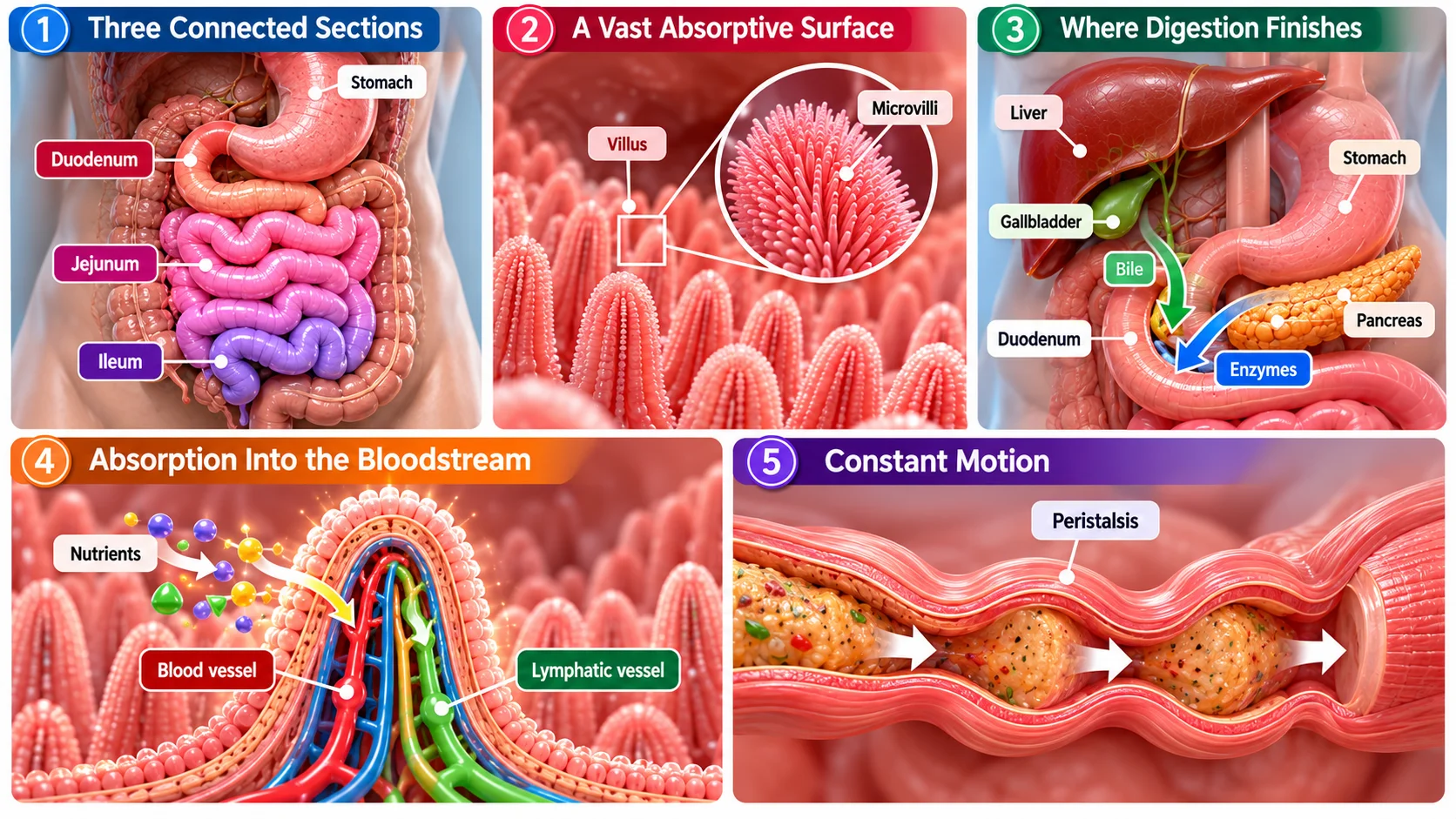
The small intestine has three parts. The duodenum, the shortest section, receives partially digested food from the stomach along with digestive secretions from the pancreas and liver. The jejunum, the middle section, is where the bulk of nutrient absorption takes place. The ileum, the final and longest section, absorbs remaining nutrients, including vitamin B12 and bile salts, before passing what's left into the large intestine.
A Vast Absorptive Surface
The inner lining of the small intestine isn't smooth. It's covered in millions of tiny, finger-like projections called villi, each of which is in turn covered in even smaller projections called microvilli. This folding and re-folding dramatically increases the surface area available for absorption — if flattened out, the small intestine's absorptive surface would cover an area roughly the size of a tennis court.
Where Digestion Finishes
Enzymes from the pancreas, along with bile from the liver and gallbladder, are released into the duodenum and continue breaking down carbohydrates, proteins, and fats into units small enough to be absorbed — simple sugars, amino acids, and fatty acids.
Absorption Into the Bloodstream
Once nutrients are broken down, they pass through the cells lining the villi and into a network of blood vessels beneath, which carry them onward, largely to the liver for further processing. Fats take a slightly different route, first entering the lymphatic system before joining the bloodstream.
Constant Motion
The small intestine moves its contents forward through coordinated, wave-like muscle contractions called peristalsis, a rhythmic squeezing action that pushes material steadily along its length, a journey that typically takes several hours from start to finish.