
Your dreams can wait, but your biological clock may not.
In today’s rapidly changing world, the decision to become a parent is increasingly shaped by career aspirations, higher education, financial independence, personal commitments and finding the right partner. As a result, many women are choosing to embrace motherhood later in life.
While these choices reflect changing social priorities and individual empowerment, reproductive ageing remains a biological reality. Advances in assisted reproductive technology, particularly oocyte cryopreservation (egg freezing), offer women an opportunity to preserve their reproductive potential and plan motherhood with greater flexibility.
Understanding the Biological Clock
Unlike men, who produce sperm continuously, women are born with a finite number of oocytes. As women age, both the number and the reproductive competence of their oocytes gradually decline.
This decline becomes more significant after the age of 35 and accelerates further in the late thirties and early forties [1].
Reproductive ageing is associated with the following changes.
Declining ovarian reserve
Reduced oocyte quality
More chromosomal abnormalities
Lower fertilization rates and reproductive potential
A higher risk of miscarriage
Lower chances of a successful pregnancy
Even women who lead a healthy lifestyle and have regular menstrual cycles may experience age-related fertility decline.
What Is Oocyte Cryopreservation?
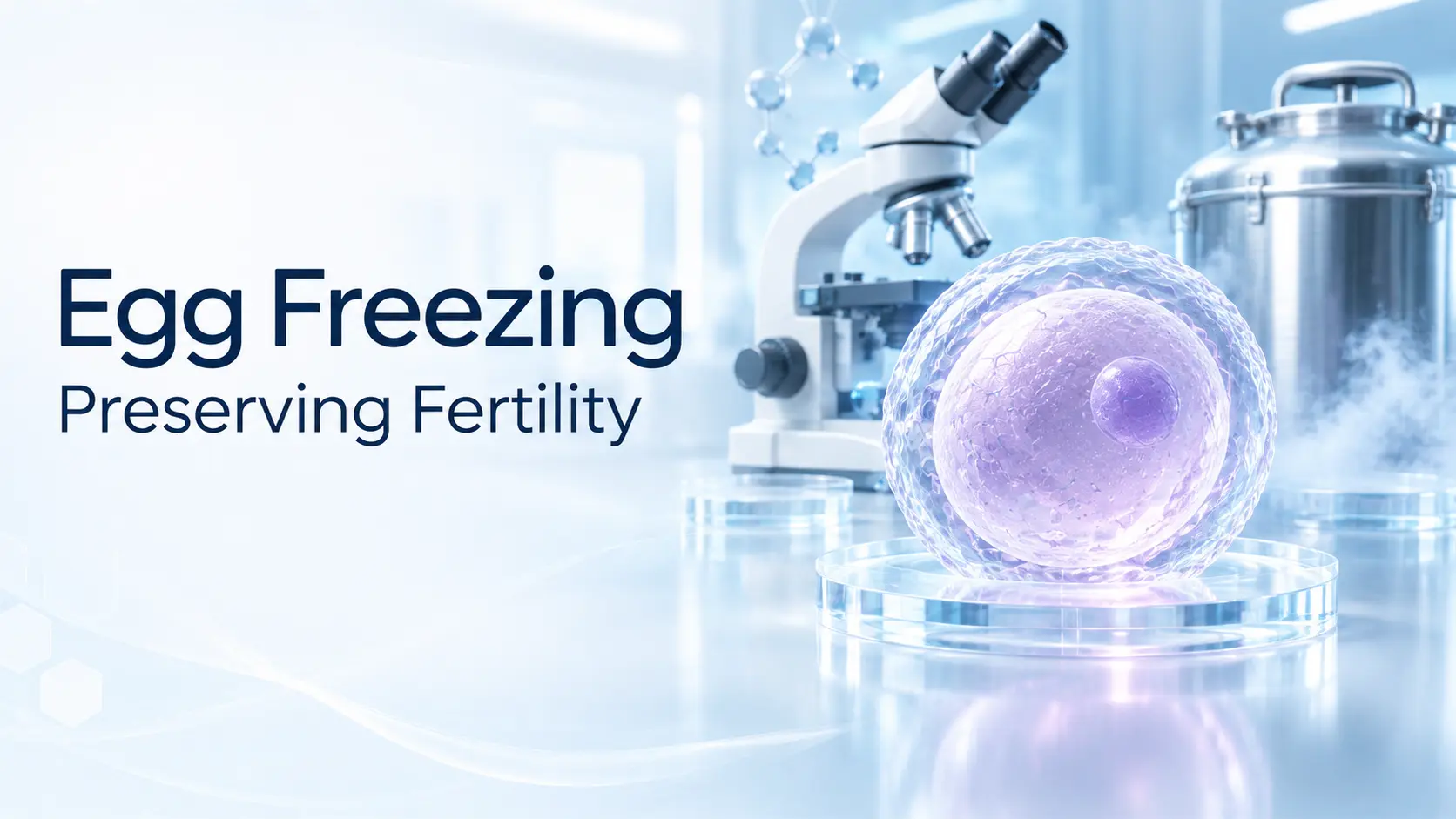
Oocyte cryopreservation, commonly known as egg freezing, is an advanced fertility preservation technique in which mature, unfertilized oocytes are collected, frozen and stored for future use.
Modern embryology laboratories use vitrification, an ultra-rapid freezing process that minimizes ice crystal formation and protects the delicate cellular structures of the oocyte [2].
The vitrified oocytes are stored in liquid nitrogen at approximately −196 °C, preserving their biological potential until they are needed for fertility treatment.
When Is the Right Time to Freeze Your Eggs?
Age at the time of egg freezing is one of the most important factors influencing future reproductive outcomes.
Freezing oocytes in the late twenties or early thirties, preferably before the age of 35, generally offers better reproductive prospects than freezing at an advanced reproductive age [2, 3]. However, the ideal timing varies with ovarian reserve, medical history, reproductive goals and individual circumstances.
Anti-Müllerian hormone (AMH) testing and an antral follicle count (AFC) can help estimate ovarian reserve and the likely response to ovarian stimulation [1]. These tests do not directly measure egg quality, nor do they guarantee a future pregnancy.
Who Should Consider Egg Freezing?
Oocyte cryopreservation may be considered by women who:
Wish to postpone motherhood for personal or professional reasons
Have not yet found a suitable partner
Are at risk of premature ovarian insufficiency
Have endometriosis or are planning ovarian surgery
Have a family history of early menopause
Require chemotherapy, radiotherapy or other treatments that may compromise fertility [1]
Fertility preservation can also be a proactive reproductive planning decision.
How Does Egg Freezing Work?
The egg-freezing process generally involves five stages.
Fertility assessment. The care team evaluates ovarian reserve and reproductive health.
Ovarian stimulation. Hormonal medication encourages multiple follicles to develop.
Oocyte retrieval. The care team collects oocytes through an ultrasound-guided procedure.
Vitrification. The embryology laboratory identifies and freezes suitable mature oocytes.
Cryostorage. The laboratory stores the vitrified oocytes in liquid nitrogen for future use.
The stimulation and retrieval process usually takes about 10–14 days.
When a woman decides to pursue pregnancy, the frozen oocytes can be warmed, fertilized using intracytoplasmic sperm injection (ICSI) and cultured into embryos suitable for transfer.
The Role of Advanced Embryology in Fertility Preservation
Successful oocyte cryopreservation requires scientific expertise, advanced laboratory infrastructure and stringent quality control.
The competence of the embryologist, the precision of the vitrification and warming protocols, the cryostorage conditions and laboratory quality management all play important roles in preserving oocyte viability.
Modern vitrification techniques can achieve high post-warming oocyte survival rates in experienced laboratories [2]. Fertilization, embryo development and live birth are separate outcomes after warming. The ultimate objective is to preserve the oocytes’ potential to develop into healthy embryos and result in a live birth.
Does Egg Freezing Guarantee Pregnancy?
Future reproductive success depends on several factors [3, 4].
Age at the time of freezing
Number of mature oocytes preserved
Intrinsic oocyte competence
Post-warming survival
Sperm quality
Embryo developmental competence
Uterine and maternal health
Egg freezing preserves the reproductive potential of the age at which the oocytes were collected. The health and pregnancy-related risks of advancing maternal age still apply. Realistic expectations and individualized fertility counselling are therefore essential.
Fertility Preservation as a Personal Choice
Every woman deserves the freedom to make informed decisions about her reproductive future, without social pressure or fear.
Egg freezing is an additional option for women whose circumstances may require them to postpone motherhood. Awareness of reproductive ageing and fertility preservation can help women consider this option alongside their personal and professional plans.
Conclusion
Modern reproductive medicine has opened new possibilities for women to balance their personal ambitions, professional achievements and reproductive aspirations. Timely fertility assessment, informed decision-making and advances in oocyte vitrification can help women preserve their reproductive potential.
The most valuable aspect of fertility preservation is the opportunity to make reproductive choices with greater awareness, confidence and flexibility.
Preserve your possibilities today, for the dreams you may choose tomorrow.
References
ESHRE Guideline Group on Female Fertility Preservation, Anderson RA, Amant F, Braat D, et al. ESHRE guideline: female fertility preservation. Human Reproduction Open. 2020, 2020(4), hoaa052. DOI
Cobo A, García-Velasco JA, Coello A, Domingo J, Pellicer A, Remohí J. Oocyte vitrification as an efficient option for elective fertility preservation. Fertility and Sterility. 2016, 105(3), 755–764.e8. DOI
Goldman RH, Racowsky C, Farland LV, Munné S, Ribustello L, Fox JH. Predicting the likelihood of live birth for elective oocyte cryopreservation: a counseling tool for physicians and patients. Human Reproduction. 2017, 32(4), 853–859. DOI
Practice Committee of the American Society for Reproductive Medicine. Evidence-based outcomes after oocyte cryopreservation for donor oocyte in vitro fertilization and planned oocyte cryopreservation: a guideline. Fertility and Sterility. 2021, 116(1), 36–47.