
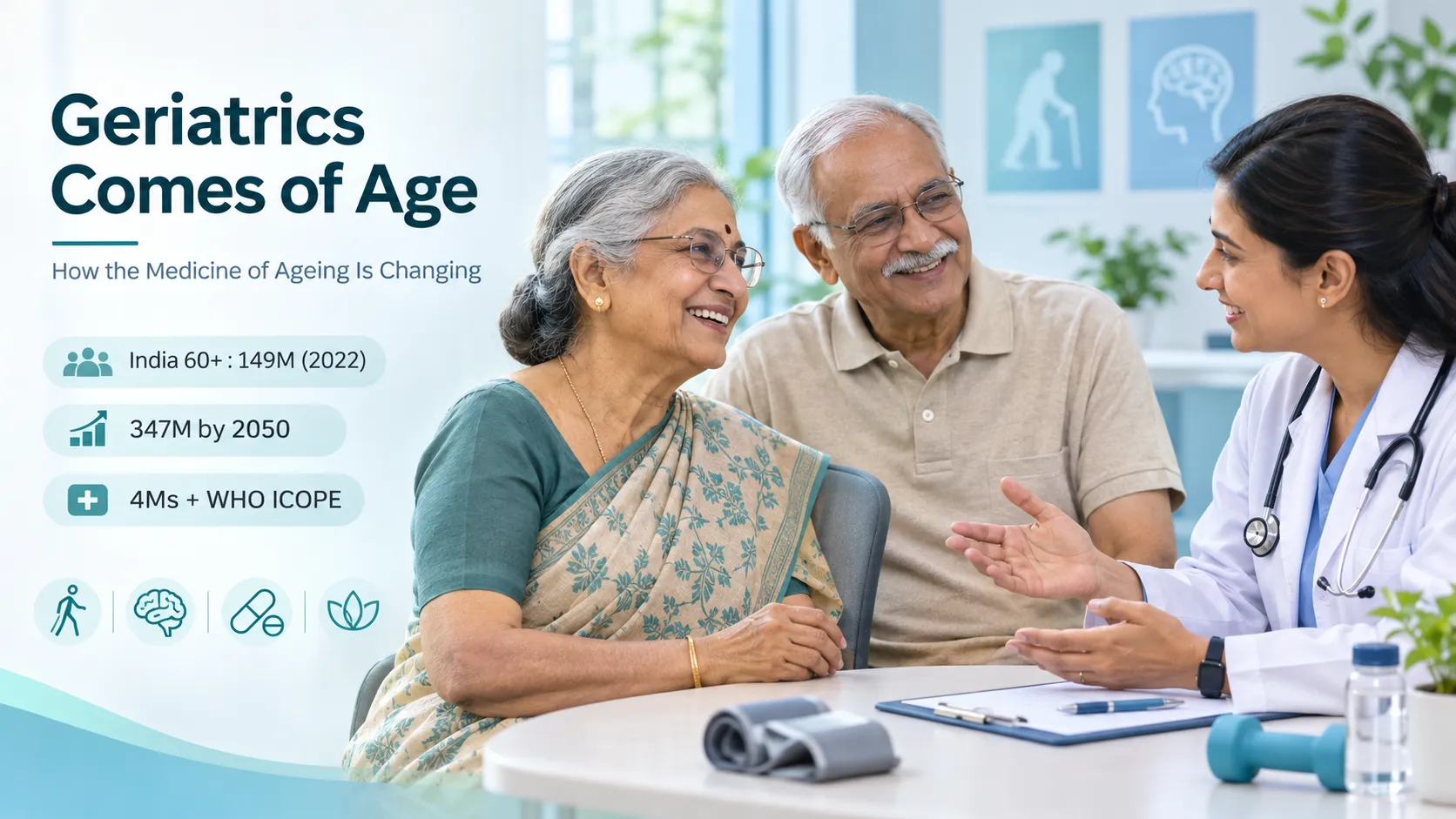
Geriatrics is moving from the margins of medicine to its centre. The reason is simple arithmetic: people are living longer, and most of the patients a doctor sees over the next two decades will be old.
Why geriatrics matters now
India had about 149 million people aged 60 and above in 2022, or 10.5% of the population. The UNFPA India Ageing Report 2023 projects that number will reach 347 million, or 20.8%, by 2050 (UNFPA India). By around 2046, older Indians are expected to outnumber children under 15.
The fastest-growing group is the very old. The same report projects the 80-plus population will grow by roughly 279% between 2022 and 2050, with a large share being widowed, dependent women. Southern states, Karnataka among them, are ageing ahead of the national average.
This is not only India's story. Worldwide, the number of people over 60 is expected to roughly double to 2.1 billion by 2050. Every health system is being forced to ask the same question: is it built for the patients it actually has?
From treating diseases to protecting function
The biggest change in geriatrics is a change of question. Instead of asking only "what disease does this patient have?", geriatricians increasingly ask "what can this person still do, and what matters to them?"
Two frameworks now carry that idea into everyday practice.
The 4Ms.
Developed in the US by the John A. Hartford Foundation and the Institute for Healthcare Improvement, the Age-Friendly Health Systems model asks every care team to cover four things for every older patient:
What Matters – the patient's own goals and care preferences
Medication – using drugs that do not interfere with mobility, thinking or those goals
Mentation – preventing and managing dementia, depression and delirium
Mobility – making sure the person moves safely every day
The idea has spread fast. Since 2017, nearly 5,000 care settings have been recognised as age-friendly, and the US Medicare system added an Age-Friendly Hospital Measure to its 2025 inpatient payment rules (Healthcare Innovation). Once a quality measure is tied to payment, it stops being optional.
WHO ICOPE.
The World Health Organization's Integrated Care for Older People approach goes further, built around intrinsic capacity: a person's combined physical and mental reserves across locomotion, cognition, vitality (nutrition), vision, hearing and mood. Health workers screen for early decline in these domains, assess, build a personal care plan and follow up. WHO released the second edition of the ICOPE handbook for primary care, which adds a pathway for urinary incontinence and draws on implementation experience from around the world.
ICOPE matters especially for countries like India. It is designed for primary care and community health workers, not specialist hospitals, so it can work where geriatricians are scarce. Indian researchers have already begun using the ICOPE screening tool in urban and rural settings, from Maharashtra to the Thar desert.