
By Dr. K. B. Suryakumar, Retired Professor of Forensic Medicine
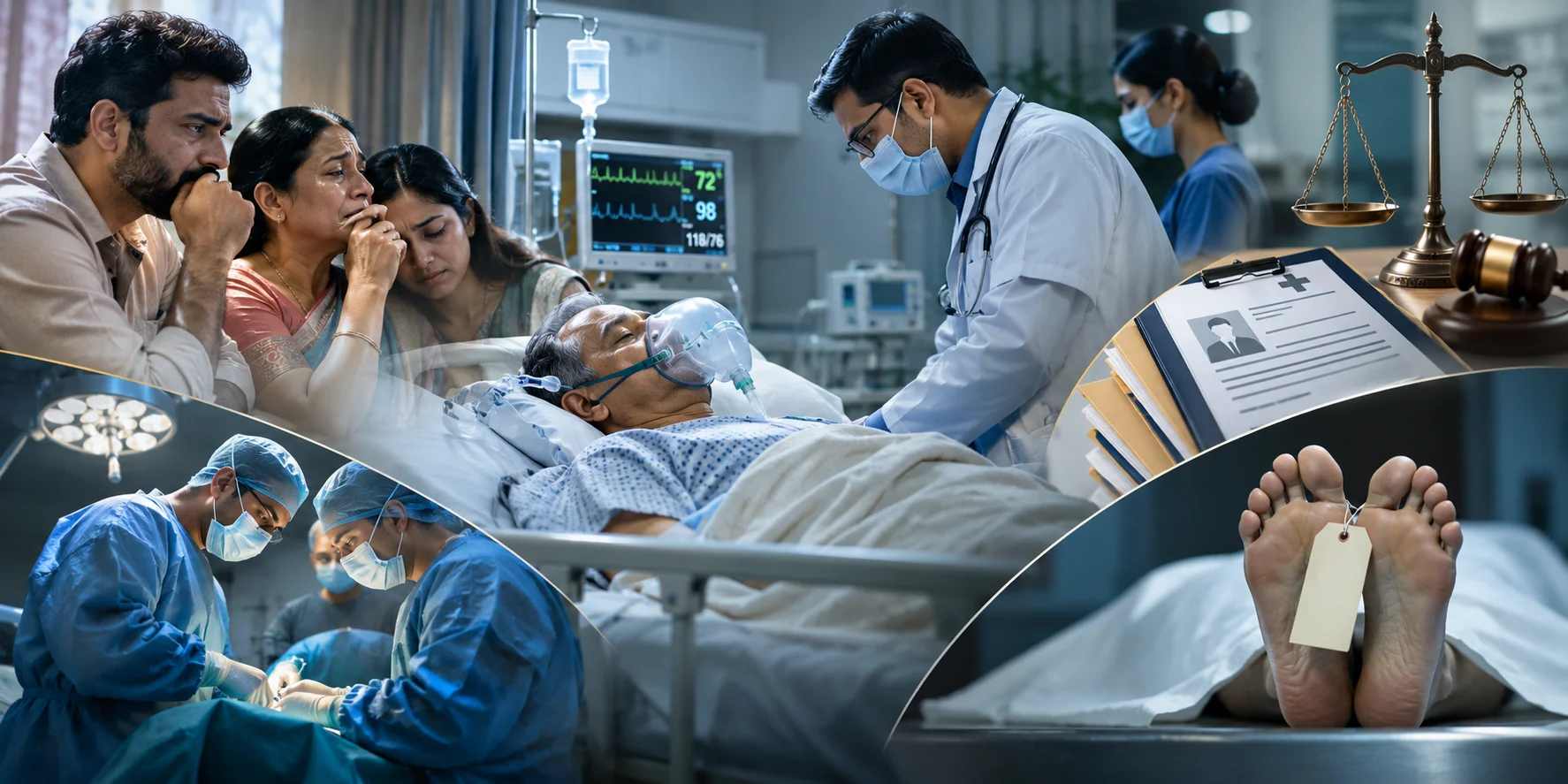
Death is an inevitable part of life, but when a patient dies during medical treatment, the loss often comes with grief, confusion and sometimes suspicion. Relatives may ask: Was everything possible done to save the patient? Was there a delay in treatment? Was the diagnosis correct? Could the death have been prevented?
These are understandable questions. However, one important fact must be remembered: a death during medical treatment does not automatically mean that medical negligence has taken place. The distinction between an unavoidable medical outcome and negligence matters to patients, doctors and the justice system.
Why can a patient die despite treatment?
Modern medicine has made remarkable advances. Intensive care, sophisticated surgery, antibiotics, ventilators and emergency procedures have saved countless lives. Yet no treatment can guarantee survival in every case.
A patient admitted with a severe heart attack, stroke, advanced cancer, serious infection or multiple injuries may die despite the best available treatment. Sometimes the disease has progressed beyond recovery before the patient reaches the hospital. In other cases, unexpected complications such as severe bleeding, cardiac arrest, drug reactions, pulmonary embolism or anaesthetic complications may occur.
Even a properly performed operation carries some risk. A complication by itself does not establish negligence. The important question is whether the medical team took reasonable precautions, recognised the complication in time and responded appropriately.
When does medical negligence arise?
Medical negligence occurs when a doctor or healthcare institution fails to provide the standard of care reasonably expected in the circumstances, and that failure causes harm to the patient.
For example, negligence may be suspected when a doctor fails to recognise an obvious emergency, delays essential treatment without justification, gives an inappropriate drug or dose, ignores serious warning signs, or fails to arrange a timely referral when the required facilities are not available.
Negligence may also arise from deficiencies in hospital systems. The lack of an emergency oxygen supply, non-functional equipment, inadequate monitoring, a shortage of trained staff or failure to respond to an emergency call may contribute to a preventable death.
However, the circumstances must be examined carefully. A doctor cannot be expected to have every possible diagnostic facility, or to achieve results beyond the capabilities of medical science. The standard is reasonable professional care, not perfection.
In Jacob Mathew v. State of Punjab (2005), the Supreme Court of India explained that a medical professional should be judged by the standard of an ordinarily competent practitioner exercising reasonable skill and care [1]. The Court also drew an important distinction: criminal prosecution requires a much higher degree of negligence, generally described as gross negligence or recklessness. Not every error of judgement or unsuccessful treatment can be treated as a criminal offence.
The law now also treats doctors differently. Section 106(1) of the Bharatiya Nyaya Sanhita, 2023, which replaces Section 304A of the Indian Penal Code, prescribes up to five years' imprisonment and a fine for causing death by negligence. For a registered medical practitioner who causes death by a negligent act while performing a medical procedure, it prescribes a lower maximum of two years' imprisonment, along with a fine.
The importance of medical records
When a patient dies during treatment and questions are raised, medical records become extremely important. The case sheet, admission notes, investigation reports, medication chart, nursing records, consent forms, operation notes and details of resuscitation help reconstruct the sequence of events.
Accurate documentation of the patient's condition, changes in vital signs, treatment given and response to treatment is essential. It helps establish whether appropriate decisions were taken at the relevant time.
The hospital should explain the circumstances of the death to the relatives with sensitivity and honesty. Families should be given appropriate information about the illness, the treatment provided and the likely cause of death. They should also be told how to obtain the medical records [2].
Maintaining proper records is not merely a legal formality. It is an important part of good medical practice and patient safety.
When is a post-mortem examination necessary?
Not every hospital death requires a medico-legal post-mortem examination. A patient with a well-established natural disease may die as an expected consequence of that illness. The treating doctor may certify the cause of death after considering the clinical history, investigations and treatment records.
However, a post-mortem examination may become necessary when the death is sudden, unexpected, unexplained or suspicious, or when there is a reasonable possibility of an accident, poisoning, assault or other unnatural cause [2].
In some cases, the relatives may request a post-mortem examination because they are not satisfied with the hospital's explanation. The appropriate authorities must then consider the circumstances and the applicable legal requirements.
A medico-legal autopsy can help determine the cause of death, identify injuries or disease, and assess whether the findings are consistent with the clinical history. Relevant samples may be preserved for toxicological, histopathological or other laboratory examination.
One point, however, must be understood: a post-mortem examination can establish the medical cause of death, but it cannot by itself establish that a particular doctor was responsible. Determining negligence requires examination of the complete medical records, treatment decisions, available facilities, expert opinions and the circumstances surrounding the death.
A balanced approach is essential
Death during medical treatment is emotionally distressing for the family and professionally difficult for the treating doctor. Relatives have every right to seek an explanation, ask questions and pursue a genuine complaint. Equally, doctors should not be subjected to threats, violence or criminal accusations merely because a patient could not be saved.
When negligence is suspected, the appropriate course is an impartial investigation by qualified medical experts. Its purpose should be to establish the facts, identify any failure in care and ensure accountability wherever necessary.
Hospitals must also learn from every unexpected death. Regular audits, emergency preparedness, adequate staffing, functioning equipment, infection control and clear communication can prevent avoidable tragedies.
Ultimately, medicine is a profession devoted to saving lives, but it cannot defeat death in every situation. A patient may die even when doctors have done everything reasonably possible. At the same time, preventable deaths must never be dismissed as unavoidable complications.
The goal should be neither to protect doctors at the cost of patients nor to blame doctors whenever treatment fails. It should be to ensure truth, accountability, compassion and continuous improvement in medical care.
References
Jacob Mathew v. State of Punjab, (2005) 6 SCC 1. Supreme Court of India.
Directorate General of Health Services, Ministry of Health and Family Welfare, Government of India. Hospital Manual (April 2025): guidelines for medico-legal work and hospital procedures.