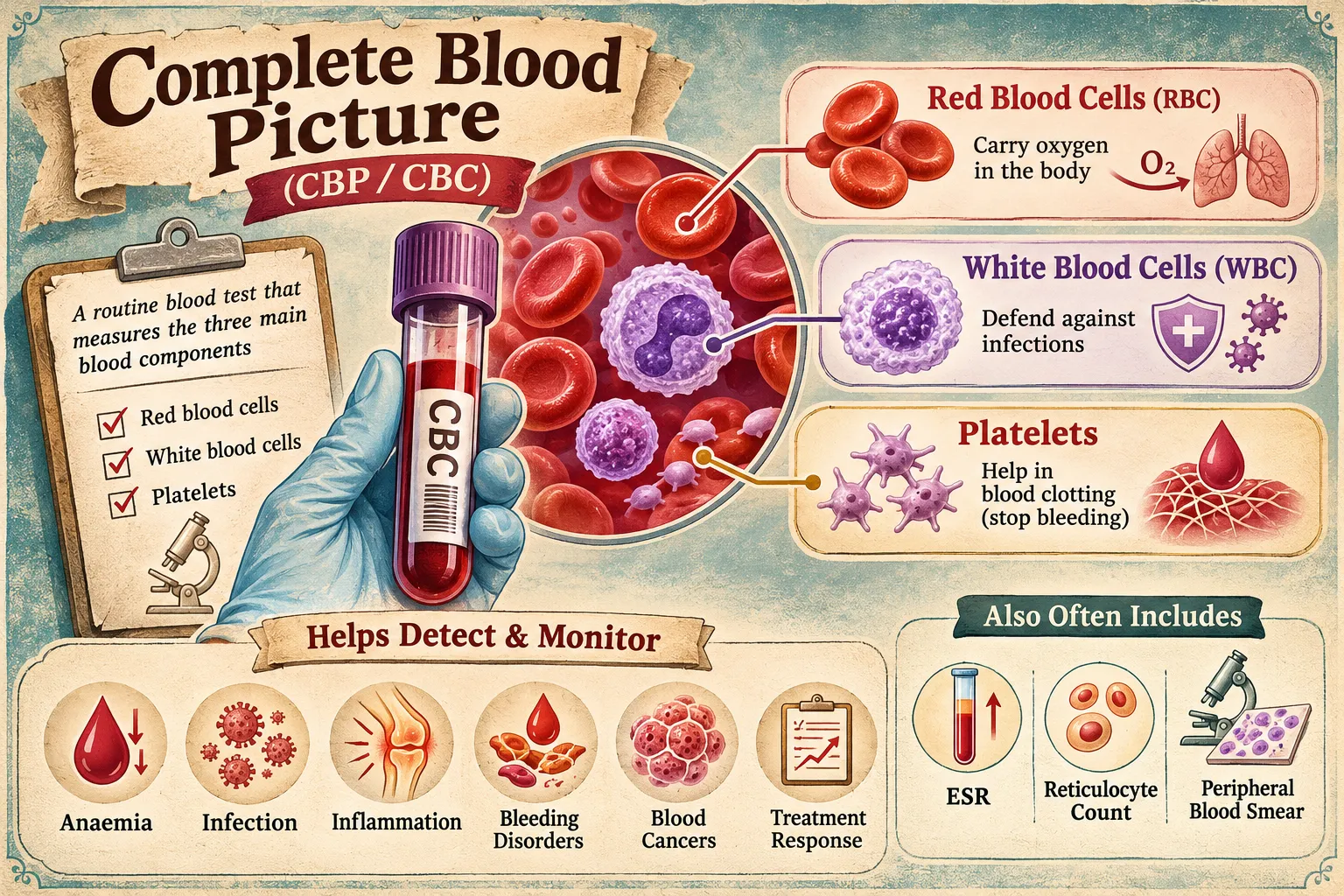
A complete blood picture (CBP), also called a complete blood count (CBC), is one of the most commonly ordered blood tests. It measures the three types of cells in blood: red blood cells, white blood cells and platelets. It helps detect anaemia, infection, inflammation, bleeding disorders and blood cancers, and is used to monitor treatment.
The normal ranges below are typical adult values. Ranges vary between laboratories, and differ for children, pregnant women and people living at high altitude. Always read results against the range printed on your own report.
Red blood cell parameters
Red blood cells (RBCs) carry oxygen from the lungs to the tissues, using the protein haemoglobin.
Haemoglobin (Hb)
The oxygen-carrying protein inside red cells, and the main test for anaemia.
Normal: men 13–17 g/dL; women 12–15 g/dL
Low: anaemia, from iron, vitamin B12 or folate deficiency, blood loss, chronic disease, kidney disease, thalassaemia or haemolysis
High: dehydration, smoking, chronic lung disease, living at high altitude, polycythaemia vera
Total RBC count
The number of red cells in a microlitre of blood.
Normal: men 4.5–5.5 million/µL; women 3.8–4.8 million/µL
Low: most anaemias
High: same causes as high Hb. A high RBC count with low MCV is a typical clue to thalassaemia trait.
Packed cell volume (PCV) / haematocrit (Hct)
The percentage of blood volume taken up by red cells.
Normal: men 40–50%; women 36–46%
Low: anaemia, overhydration
High: dehydration, polycythaemia. A rising PCV in dengue is a warning sign of plasma leakage.
Red cell indices
These are calculated from Hb, RBC count and PCV. They describe the size and haemoglobin content of red cells, and help classify anaemia.
Mean corpuscular volume (MCV): the average size of a red cell.
Normal: 80–100 fL
Low (microcytic): iron deficiency, thalassaemia, anaemia of chronic disease
High (macrocytic): vitamin B12 or folate deficiency, alcohol, liver disease, hypothyroidism, some medicines
Mean corpuscular haemoglobin (MCH): the average amount of haemoglobin in each red cell.
Normal: 27–32 pg
Low: iron deficiency, thalassaemia
High: usually accompanies a high MCV
Mean corpuscular haemoglobin concentration (MCHC): the concentration of haemoglobin within red cells.
Normal: 32–36 g/dL
Low (hypochromic): iron deficiency, thalassaemia
High: hereditary spherocytosis; also sample artefacts such as clumping or lipaemia
Red cell distribution width (RDW): how much red cells vary in size.
Normal: RDW-CV 11.5–14.5%
High: mixed cell sizes, as in iron, B12 or folate deficiency, or recent blood loss. A low MCV with a high RDW points towards iron deficiency; a low MCV with a normal RDW points towards thalassaemia trait.
White blood cell parameters
White blood cells (WBCs, leucocytes) defend the body against infection and are involved in allergy and inflammation.
Total leucocyte count (TLC / total WBC count)
The total number of white cells in a microlitre of blood.
Normal: 4,000–11,000/µL
High (leucocytosis): bacterial infections, inflammation, injury, stress, steroid use, pregnancy, smoking, leukaemia
Low (leucopenia): viral infections such as dengue, typhoid, severe infection, vitamin B12 or folate deficiency, bone marrow disorders, chemotherapy and some other medicines, autoimmune diseases
Differential leucocyte count (DLC)
The DLC breaks the total count into five types of white cell, each reported as a percentage. Multiplying a percentage by the TLC gives the absolute count, which is more meaningful than the percentage alone.
Neutrophils: the first responders to bacterial infection.
Normal: 40–75% (about 2,000–7,500/µL)
High (neutrophilia): bacterial infections, inflammation, tissue damage, steroids
Low (neutropenia): viral infections, typhoid, chemotherapy, bone marrow failure, some medicines. A very low count raises the risk of serious infection.
Lymphocytes: key to immunity against viruses and to antibody production.
Normal: 20–40% (about 1,000–4,000/µL)
High (lymphocytosis): viral infections, tuberculosis, whooping cough, chronic lymphocytic leukaemia
Low (lymphopenia): steroids, HIV, severe illness, some autoimmune diseases, chemotherapy
Monocytes: clean up dead cells and germs, and become macrophages in tissues.
Normal: 2–10%
High (monocytosis): chronic infections such as tuberculosis, recovery from acute infection, inflammatory bowel disease, some leukaemias
Eosinophils: involved in allergy and in fighting parasites.
Normal: 1–6%
High (eosinophilia): allergies, asthma, eczema, worm infestations (common in India), some medicines; tropical pulmonary eosinophilia
Basophils: release histamine in allergic reactions.
Normal: 0–2%
High (basophilia): uncommon; can occur in allergic conditions and in myeloproliferative disorders such as chronic myeloid leukaemia
Platelet parameters
Platelets (thrombocytes) are small cell fragments that help blood clot and stop bleeding.
Platelet count
Normal: 1.5–4.5 lakh/µL (150,000–450,000/µL)
Low (thrombocytopenia): dengue, malaria and other viral infections, immune thrombocytopenia (ITP), liver disease with an enlarged spleen, bone marrow disorders, some medicines. Risk of spontaneous bleeding rises mainly below about 20,000/µL. A falsely low count can occur when platelets clump in the sample tube (pseudothrombocytopenia), so an unexpected low count should be checked on a smear.
High (thrombocytosis): iron deficiency, infection, inflammation, after surgery or removal of the spleen, and some bone marrow disorders
Mean platelet volume (MPV)
The average size of platelets. Young platelets are larger.
Normal: about 7.5–11.5 fL
High: platelets being destroyed and replaced quickly, as in ITP
Low: reduced production by the bone marrow
Peripheral blood smear
Many labs include a peripheral smear with the CBP. A drop of blood is spread on a slide, stained and examined under a microscope. It confirms the machine counts and shows what numbers cannot, such as:
red cell shapes and colour (for example target cells, sickle cells, fragmented cells)
abnormal or immature white cells, including blast cells in leukaemia
platelet clumps
malaria parasites
Often reported alongside
Erythrocyte sedimentation rate (ESR): how fast red cells settle in a tube over one hour. It is a non-specific marker of inflammation.
Normal: men 0–15 mm/hr; women 0–20 mm/hr (rises with age)
High: infections, tuberculosis, autoimmune diseases, anaemia, pregnancy, multiple myeloma
Reticulocyte count: the proportion of young red cells, showing how actively the bone marrow is making new red cells. Not part of a routine CBP, but often added when anaemia is found.
Normal: 0.5–2.5%
High: bleeding, haemolysis, or response to iron or B12 treatment
Low: bone marrow failure or nutritional deficiency that has not yet been treated
This article is for general information. A single abnormal value is not a diagnosis; results must be interpreted by a doctor along with symptoms, examination and other tests.