What It Is
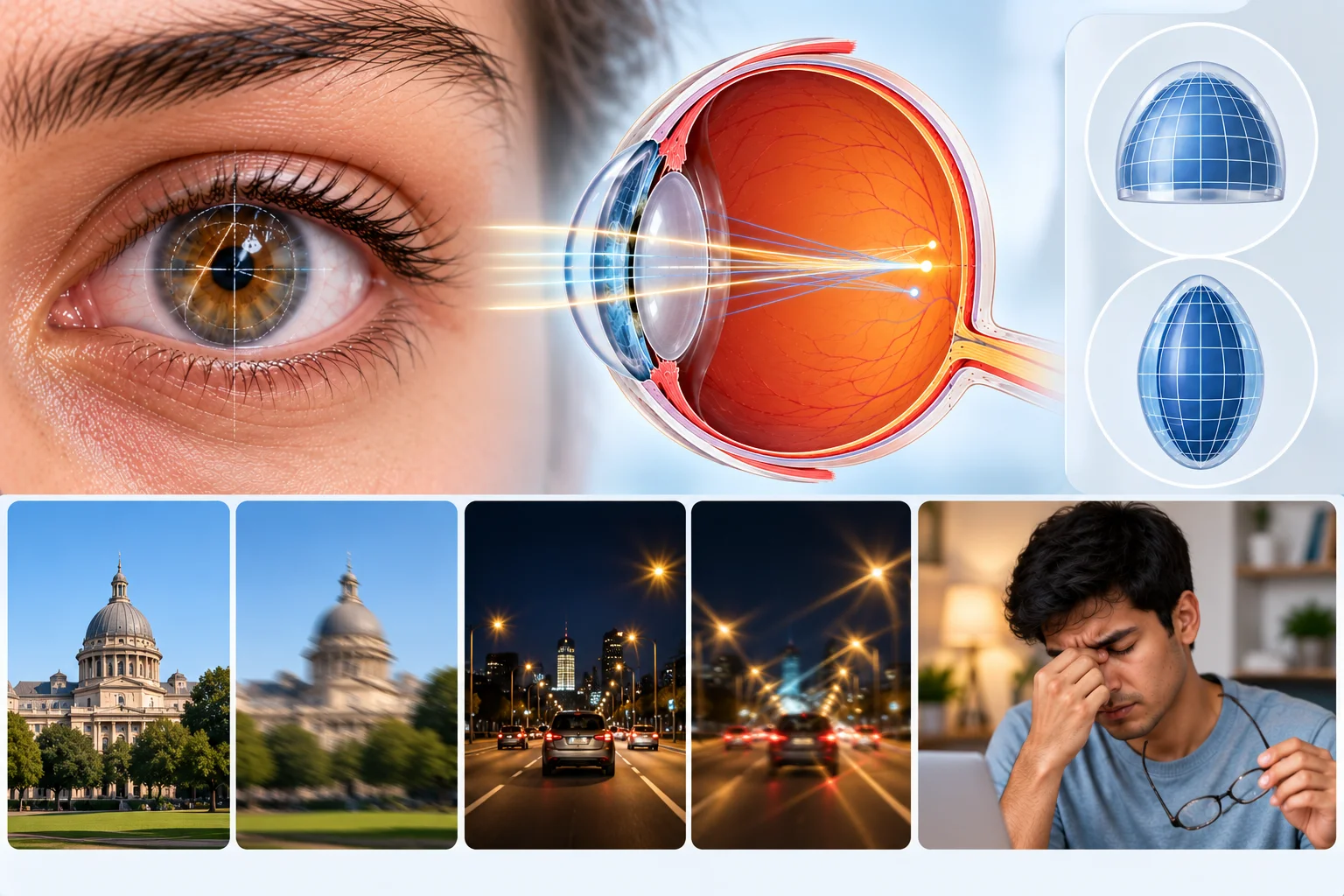
Astigmatism is a common refractive error caused by an irregularly shaped cornea or lens, resulting in blurred or distorted vision at any distance.
How It Develops
A healthy cornea is generally shaped like a smooth, evenly curved dome. In astigmatism, the cornea or lens has an uneven curve, more like the shape of an egg or a rugby ball rather than a sphere. This irregular shape causes light entering the eye to focus at more than one point rather than a single clear point, resulting in blurred or stretched-looking vision. Astigmatism can be present from birth and often occurs alongside myopia or hyperopia.
General Symptoms
Common symptoms of astigmatism include blurred or distorted vision at both near and far distances, eye strain, headaches, and sometimes difficulty seeing clearly at night.
General Treatment Approaches
Astigmatism is commonly corrected with specially shaped glasses or contact lenses designed to compensate for the eye's uneven curvature. Refractive surgery is also an option for some people, particularly once vision has stabilized.
Background
Astigmatism was first formally described and named in the early 19th century, as researchers developed a clearer understanding of the eye's optical properties and the specific ways an irregular corneal shape could distort vision. The development of specialized corrective lenses designed to counteract this specific type of distortion followed shortly after, and astigmatism correction remains a routine part of standard eye examinations and eyewear prescriptions today.