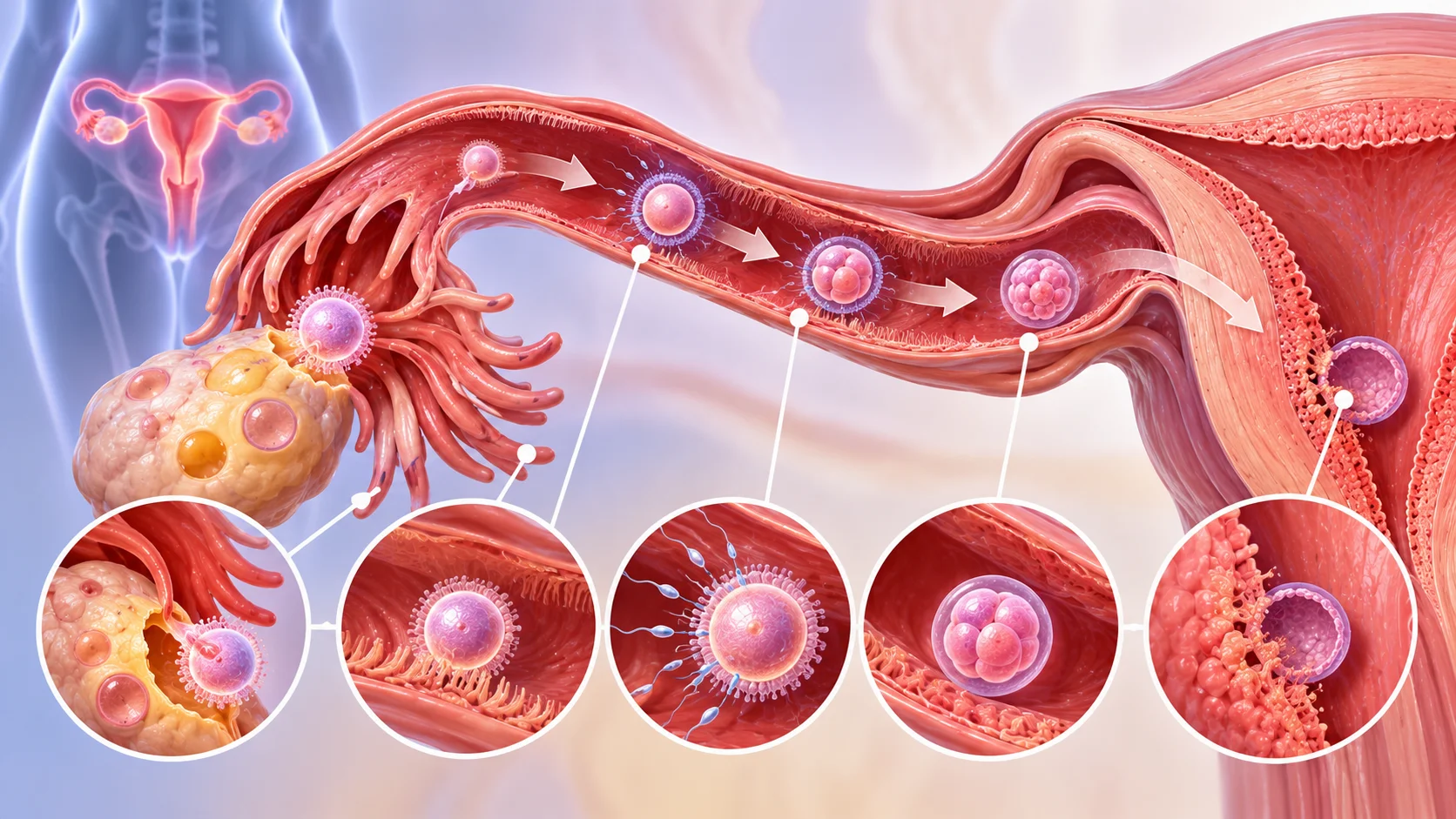
The fallopian tubes are a pair of narrow, muscular tubes that connect the ovaries to the uterus, forming an essential link in the female reproductive system.
Capturing the Egg
Each month, when an egg is released from an ovary during ovulation, it doesn't travel to the fallopian tube on its own. Instead, finger-like projections at the end of the tube nearest the ovary, called fimbriae, sweep over the surface of the ovary and help guide the released egg into the opening of the tube.
Transporting the Egg
Once inside the fallopian tube, the egg is moved along toward the uterus through a combination of two mechanisms: tiny hair-like structures called cilia, which line the inside of the tube and create a gentle, coordinated current, and rhythmic contractions of the tube's muscular walls. Together, these movements guide the egg through the tube over a period of several days.
The Site of Fertilization
The fallopian tube is typically where fertilization occurs, if it happens at all. If sperm are present following intercourse, they travel up through the uterus and into the fallopian tubes, where fertilization of the egg can take place in the outer portion of the tube. If fertilization occurs, the fertilized egg continues its journey toward the uterus, where it may implant in the uterine lining.
When Fertilization Doesn't Occur
If the egg isn't fertilized while in the fallopian tube, it continues its passage toward the uterus and is eventually shed from the body along with the uterine lining during menstruation, as part of the normal monthly reproductive cycle.
Background
The fallopian tubes are named after the 16th-century Italian anatomist Gabriele Falloppio, who provided some of the earliest detailed anatomical descriptions of these structures. Understanding of their specific role in transporting eggs and facilitating fertilization developed considerably over subsequent centuries, aided by advances in microscopy that allowed researchers to directly observe the cilia and other structures responsible for moving the egg along the tube.