Hair and nails are often thought of as purely cosmetic, but both are living structures — or rather, structures produced by living cells — that serve genuine physiological purposes.
How Hair Grows
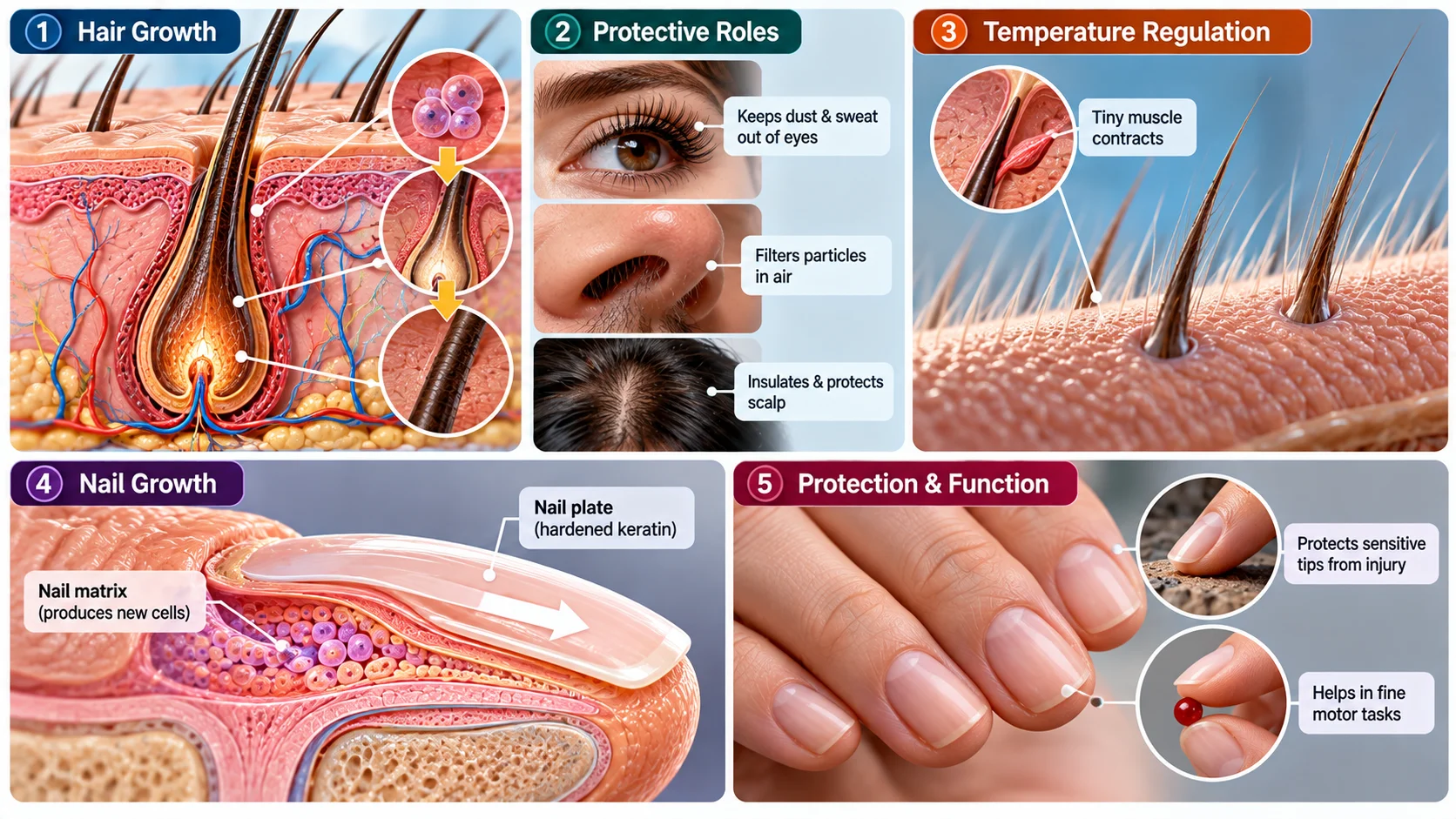
Each hair grows from a follicle embedded in the skin. At the base of the follicle, living cells divide rapidly, producing new hair cells that are pushed upward and, in the process, fill with a tough protein called keratin and die, forming the hard, visible strand of hair. This means the visible part of every hair is actually non-living tissue, while all the active growth happens below the skin's surface.
Hair's Protective Roles
Hair serves several protective functions depending on where it grows. Eyebrows and eyelashes help keep sweat, dust, and debris out of the eyes. Nasal hair filters particles from inhaled air. Scalp hair provides some insulation and protection against sun exposure for the head.
Regulating Temperature
Tiny muscles attached to each hair follicle can contract, pulling the hair more upright — the source of goosebumps. In animals with thicker fur, this traps a layer of insulating air near the skin; in humans, this response is largely a functional remnant of that same reflex.
How Nails Grow
Nails grow from a region called the nail matrix, located beneath the base of the nail, near the cuticle. Living cells here produce keratin, the same protein found in hair, which hardens into the flat, protective nail plate as it's pushed forward and outward from the growing edge.
Protecting the Fingertips
Nails serve a genuinely protective function, shielding the sensitive tips of fingers and toes from injury, and also support fine motor tasks by providing a firm surface that helps with tasks like picking up small objects, something notably harder to do without them.