What It Is
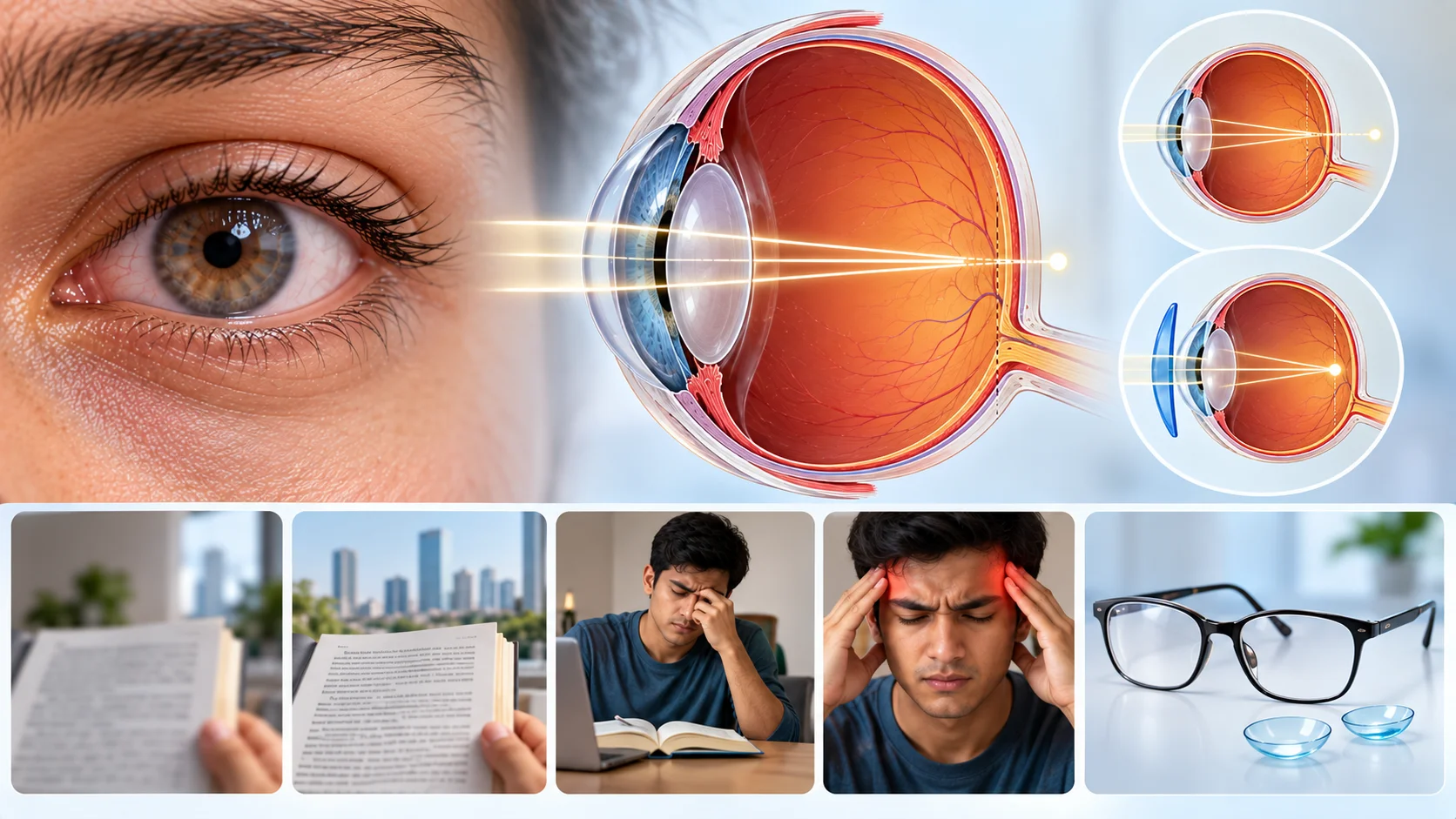
Hyperopia, commonly known as farsightedness, is a refractive error in which close objects appear blurry while distant objects may remain relatively clear.
How It Develops
Hyperopia occurs when the eyeball is slightly shorter than normal, or when the cornea is flatter than usual. This causes light entering the eye to focus at a point behind the retina rather than directly on it, making it harder for the eye to bring close-up objects into clear focus. Mild hyperopia is common and often not noticeable in younger people, since the eye's lens can partly compensate for it, but this compensating ability declines with age.
General Symptoms
Common symptoms of hyperopia include blurry vision when looking at close objects, eye strain, headaches, particularly after reading or close-up work, and, in some cases, difficulty focusing that leads to squinting.
General Treatment Approaches
Hyperopia is commonly corrected with glasses or contact lenses that help redirect light to focus properly on the retina. Refractive surgery is also an option for some people once vision has stabilized. Mild cases sometimes don't require correction at all, particularly in younger people whose eyes can naturally compensate.
Background
Corrective lenses for farsightedness, using convex lenses, have been used since around the 13th century, among the earliest applications of corrective eyewear in history. A more detailed understanding of the eye's optical structure and the specific mechanisms behind hyperopia developed over subsequent centuries, and hyperopia remains one of the most common and well-understood refractive errors managed in routine eye care today.