What It Is
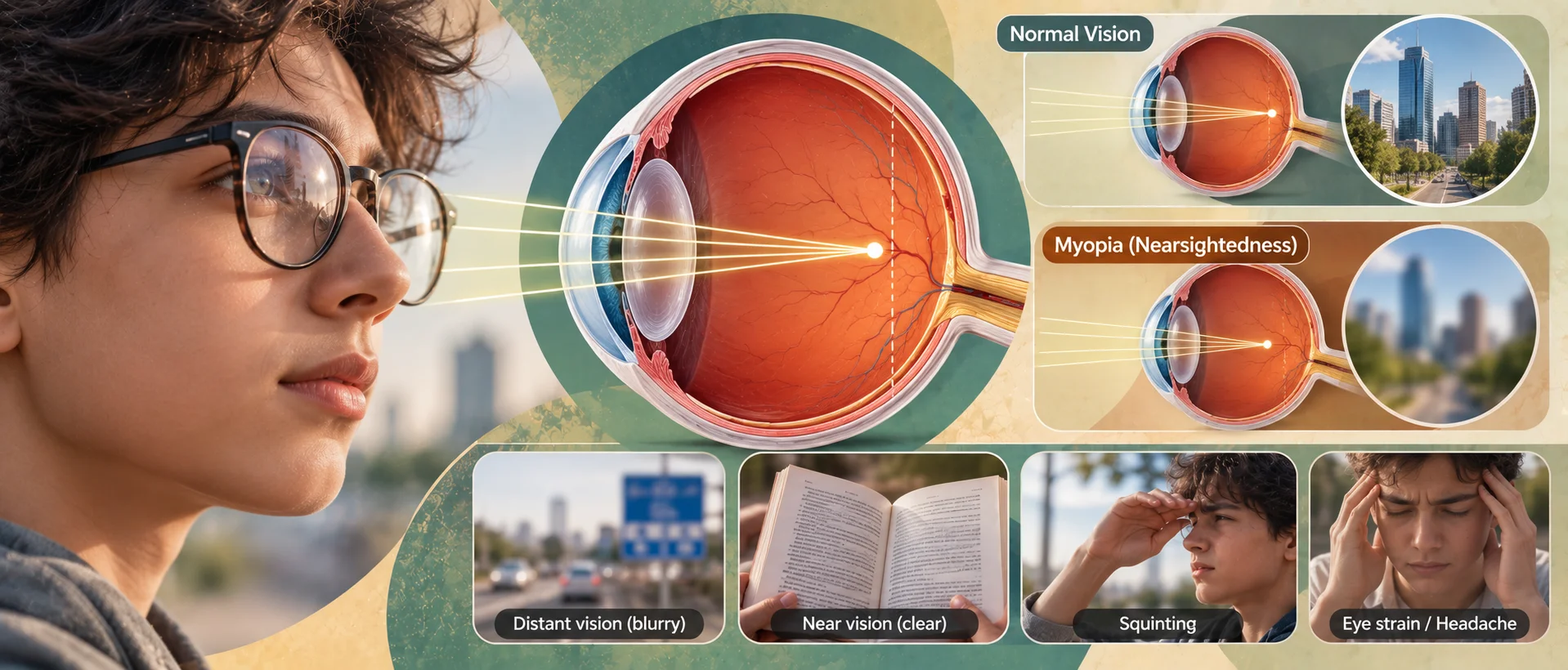
Myopia, commonly known as nearsightedness, is a refractive error in which distant objects appear blurry while close objects remain clear.
How It Develops
Myopia occurs when the eyeball is slightly longer than normal, or when the cornea is more curved than usual. This causes light entering the eye to focus at a point in front of the retina rather than directly on it, resulting in a blurred image for distant objects. Myopia often develops during childhood and adolescence and can continue to progress gradually until early adulthood, and it's influenced by a combination of genetic factors and, increasingly, environmental factors such as limited outdoor time.
General Symptoms
The main symptom of myopia is difficulty seeing distant objects clearly, such as road signs or a classroom board, while close-up vision, such as reading, generally remains unaffected. Other common signs include squinting to see distant objects, eye strain, and headaches related to visual effort.
General Treatment Approaches
Myopia is commonly corrected with glasses or contact lenses, which help refocus light directly onto the retina. Refractive surgery, such as LASIK, is another option for some people once their vision has stabilized in adulthood. In children, certain specialized approaches are also used with the goal of slowing the progression of myopia over time.
Background
Corrective lenses for nearsightedness have been used since at least the 15th century, with concave lenses recognized early on as a way to correct this specific type of blurred vision. Understanding of the eye's optical structure and why myopia occurs developed considerably further in the 19th and 20th centuries, and in recent decades, rising rates of myopia in children worldwide have made it an active area of ongoing eye health research.