What It Is
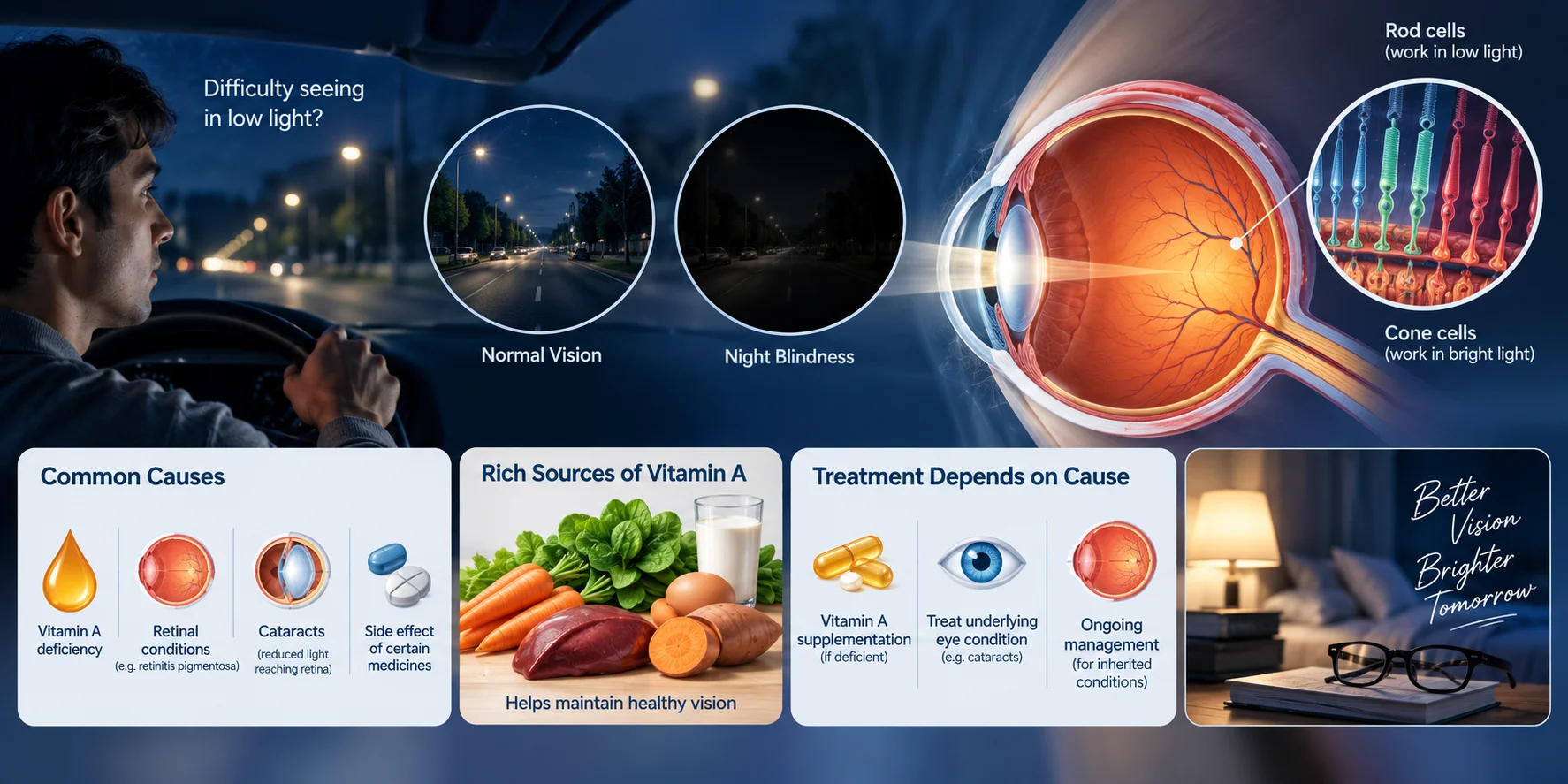
Night blindness, medically known as nyctalopia, is a condition involving difficulty seeing in low light or darkness, often much more pronounced than the mild adjustment period most people experience when moving from a bright area into a dim one.
How It Develops
Night vision relies heavily on rod cells within the retina, which are specifically responsible for detecting light in low-light conditions. Night blindness can develop for several different reasons, including vitamin A deficiency, since this nutrient is essential for the chemical processes rod cells use to detect light, or as a symptom of underlying eye conditions that specifically affect rod cell function, such as retinitis pigmentosa. It can also occur as a side effect of certain eye conditions like cataracts, which reduce the overall amount of light reaching the retina.
General Symptoms
The main symptom of night blindness is significant difficulty seeing in dim lighting or darkness, such as struggling to see clearly while driving at night or navigating a dimly lit room, well beyond the brief adjustment period typically experienced when entering a darker environment.
General Treatment Approaches
Treatment for night blindness depends entirely on its underlying cause. When related to vitamin A deficiency, dietary correction or supplementation can often improve symptoms considerably. When related to an underlying eye condition such as retinitis pigmentosa or cataracts, treatment focuses on addressing that specific condition where possible, though in the case of certain inherited retinal conditions, the underlying night vision difficulty may not be fully correctable.
Background
The connection between vitamin A deficiency and night blindness was recognized in various forms throughout history, with certain ancient remedies for night vision problems, such as consuming liver, now understood to have worked because liver is a rich source of vitamin A. This connection was scientifically confirmed in the early 20th century as vitamins were being systematically identified and studied, and vitamin A deficiency remains a significant and largely preventable cause of night blindness in parts of the world today.