What It Is
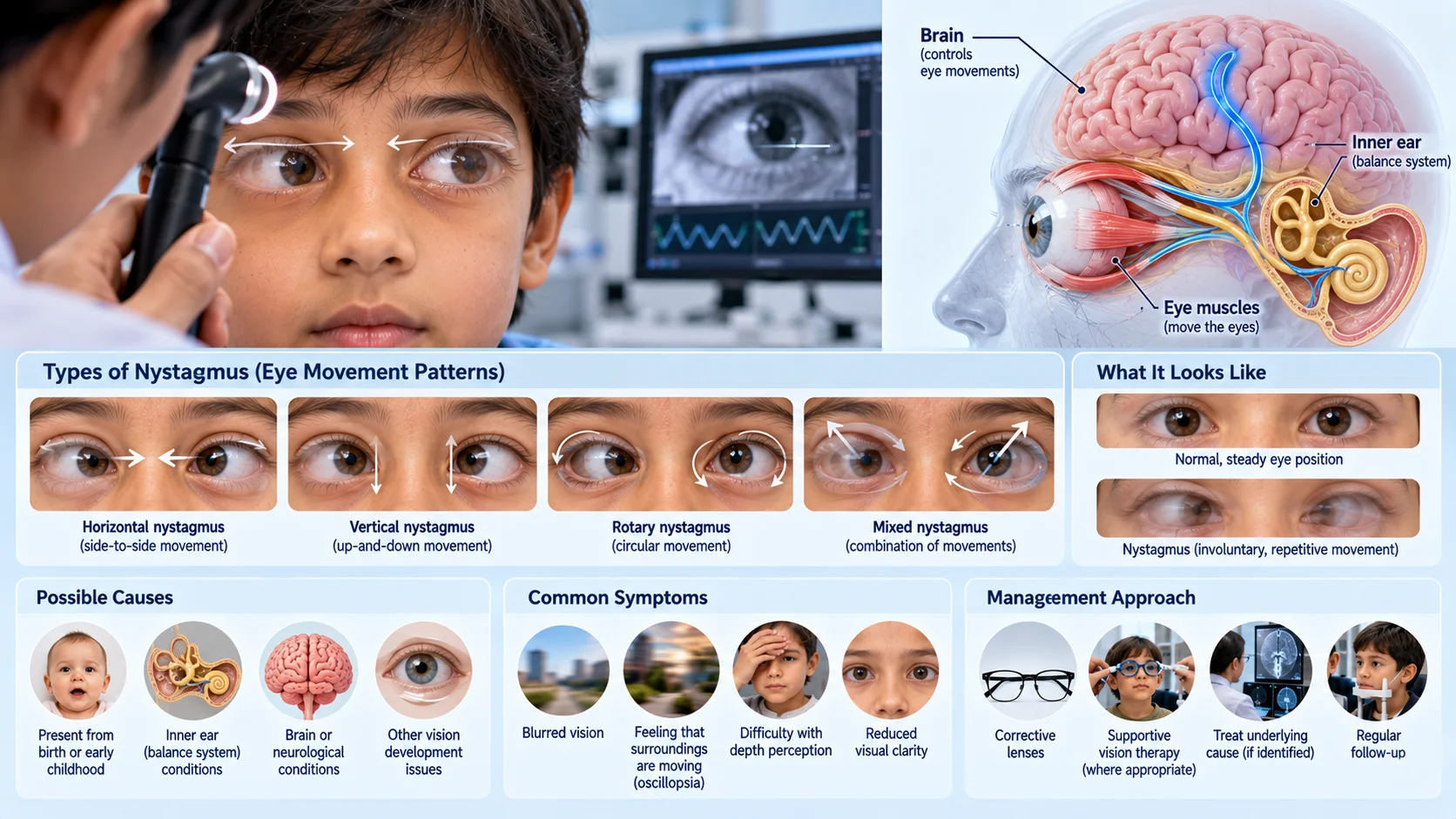
Nystagmus is a condition involving repetitive, involuntary movements of the eyes, which can occur in various directions and patterns.
How It Develops
Nystagmus can develop for a range of different reasons. Some forms are present from birth or develop in early infancy, often related to how the visual system develops during that early period. Other forms develop later in life, related to conditions affecting the inner ear's balance system, the brain regions responsible for controlling eye movement, or certain neurological conditions more broadly, since eye movement control involves a closely coordinated system linking the eyes, inner ear, and brain.
General Symptoms
The main feature of nystagmus is the involuntary, repetitive eye movement itself, which can be side-to-side, up and down, or rotational, and can vary in speed and intensity. Depending on the underlying cause and severity, nystagmus can be associated with reduced visual clarity, difficulty with depth perception, or a sensation that the surrounding environment appears to be moving, known as oscillopsia.
General Treatment Approaches
Treatment for nystagmus depends heavily on its underlying cause. When nystagmus is related to another identifiable condition, treatment often focuses on addressing that underlying cause where possible. For nystagmus present from early life, treatment often focuses on optimizing visual function through corrective lenses and other supportive measures, since the involuntary eye movement itself frequently can't be fully eliminated.
Background
Nystagmus has been recognized and described as a distinct eye movement pattern for a long time, but a detailed understanding of the many different neurological and inner-ear-related pathways that can produce it developed considerably over the 20th century, aided by advances in neurology and vestibular, or balance-related, research. Because nystagmus can result from such a wide range of underlying causes, identifying the specific reason behind it remains an important diagnostic step whenever it's newly noticed.