
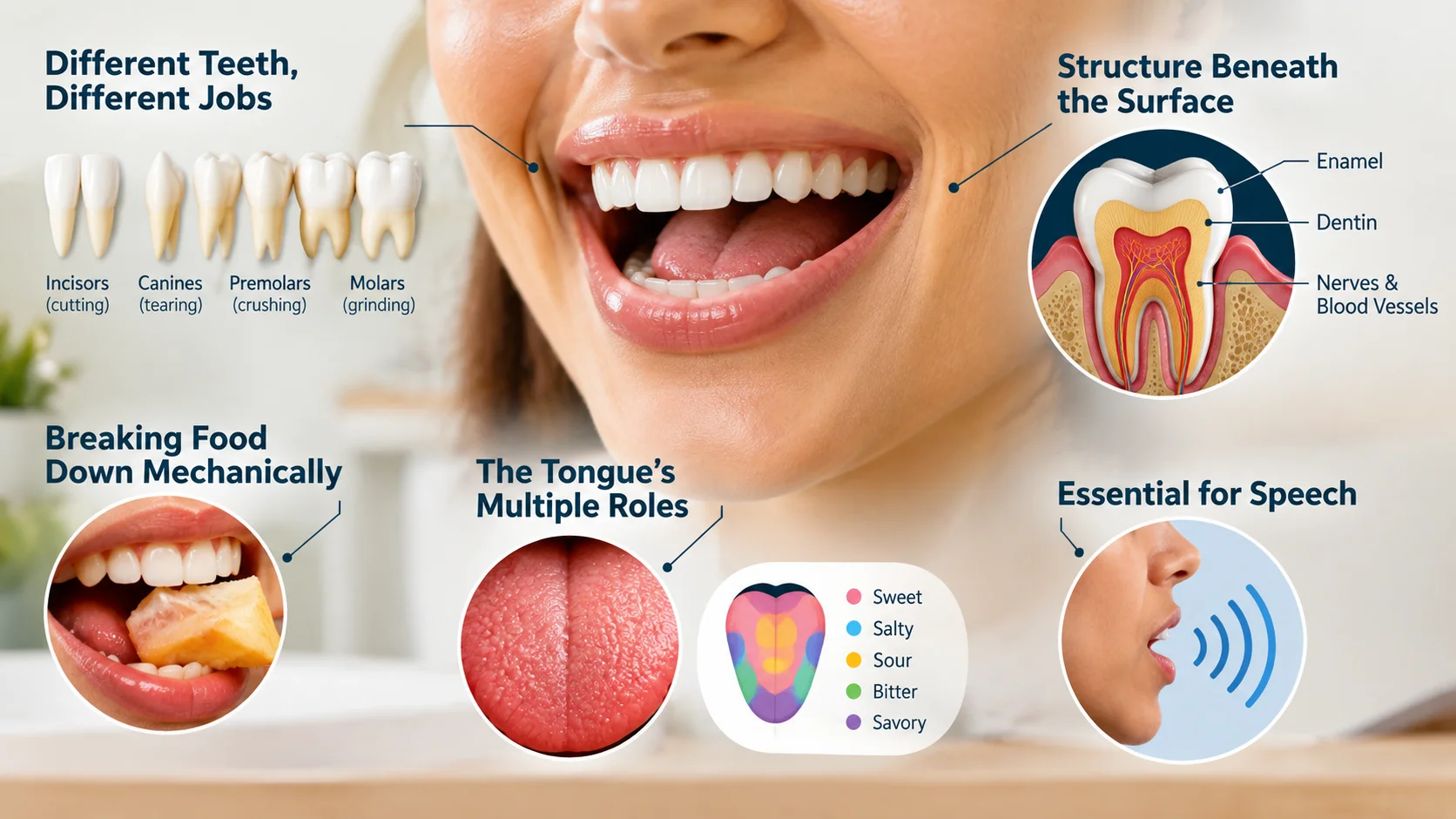
The teeth and tongue work closely together at the very start of the digestive process, handling the mechanical breakdown of food and playing a central role in speech and taste.
Different Teeth, Different Jobs
Adult humans typically have 32 teeth, shaped differently depending on their role. Incisors, at the front, are flat and sharp, designed for cutting and biting into food. Canines are pointed, suited for tearing. Premolars and molars, further back, have broad, ridged surfaces designed for crushing and grinding food into smaller pieces before swallowing.
Structure Beneath the Surface
Each tooth is covered by enamel, the hardest substance in the human body, which protects the more sensitive layers beneath. Under the enamel lies dentin, a bony tissue, and at the tooth's core is a chamber containing nerves and blood vessels that keep the tooth alive and connected to sensation.
Breaking Food Down Mechanically
Chewing, or mastication, serves a critical digestive function: it increases the surface area of food, making it easier for digestive enzymes to act on it later, and reduces food to a size and consistency that can be swallowed safely.
The Tongue's Multiple Roles
The tongue is a highly flexible muscle that manipulates food during chewing, positioning it between the teeth and later forming it into a rounded mass to be swallowed. It's covered in small bumps called papillae, many of which house taste buds capable of detecting different taste qualities — sweet, salty, sour, bitter, and savory.
Essential for Speech
Beyond its digestive role, the tongue is essential for forming speech sounds, working together with the lips, teeth, and roof of the mouth to shape airflow into the distinct sounds that make up spoken language, a function entirely separate from its digestive work.