The bladder is a hollow, muscular organ located in the lower abdomen, functioning as the body's storage tank for urine before it's eliminated.
A Flexible Container
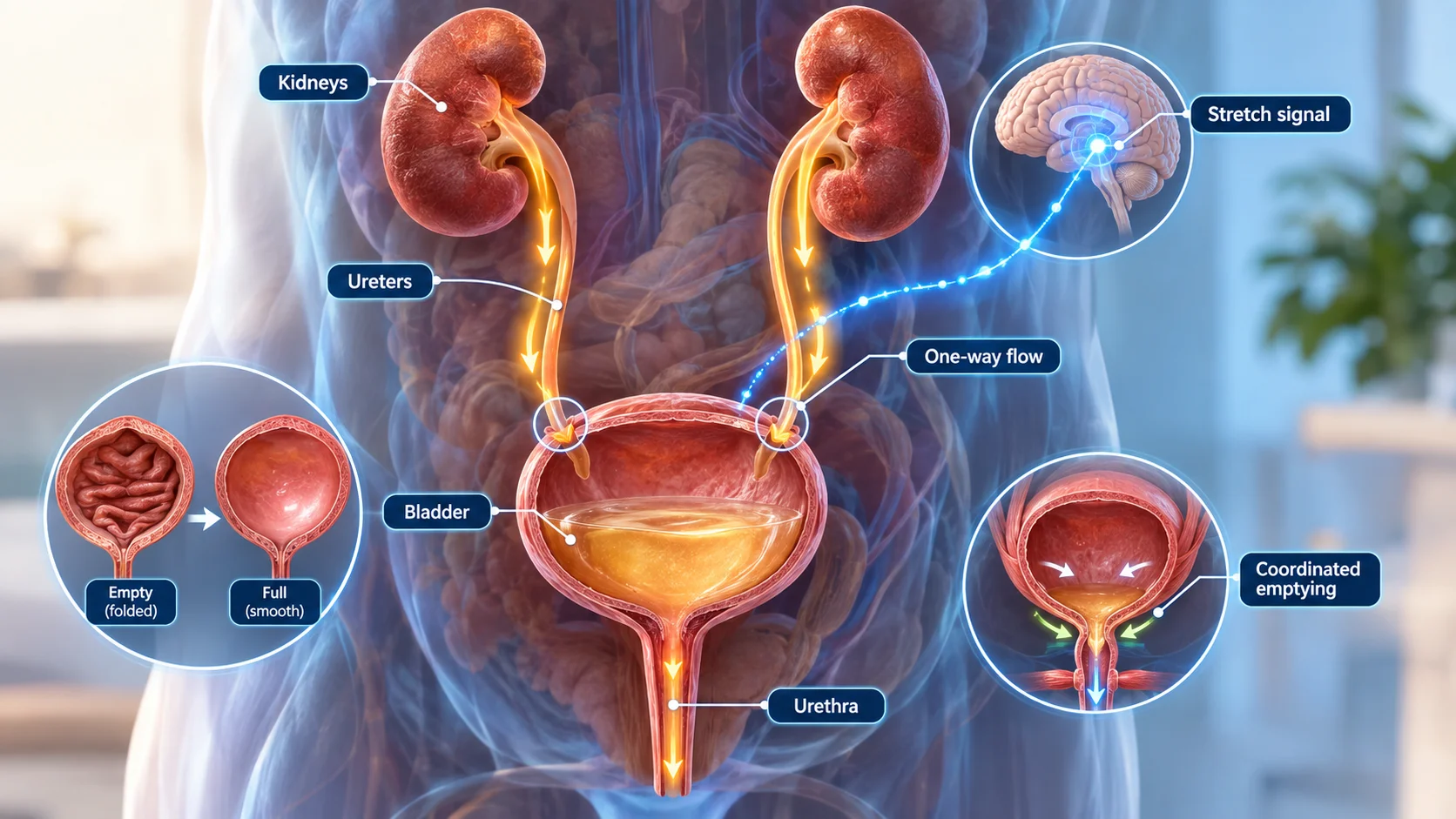
The bladder wall is made of a specialized type of muscle tissue that allows it to stretch considerably as it fills, then contract firmly to empty. An empty bladder is roughly the size of a small pear, but it can expand many times that volume as urine collects, thanks to a lining that folds in on itself when empty and smooths out as the bladder fills.
Filling and Signaling
Urine arrives continuously from the kidneys via two tubes called ureters, entering the bladder in small amounts. As the bladder fills, stretch receptors in its walls send signals to the brain, initially registering as a mild awareness and gradually intensifying into the urge to urinate as it approaches capacity.
Voluntary and Involuntary Control
Two muscular rings, called sphincters, control the release of urine from the bladder. The inner sphincter operates automatically, without conscious control, while the outer sphincter is under voluntary control, allowing a person to consciously hold urine or choose when to release it, within limits.
Coordinated Emptying
When it's time to urinate, the brain signals the bladder's muscular wall to contract while simultaneously relaxing the sphincters, allowing urine to flow out through the urethra. This is a coordinated process between the nervous system and multiple muscle groups working in sequence.
A Two-Way Protective Design
The point where the ureters enter the bladder is designed to act as a one-way valve, allowing urine to flow in from the kidneys while preventing it from flowing backward, helping protect the kidneys from pressure changes that occur as the bladder fills and empties.