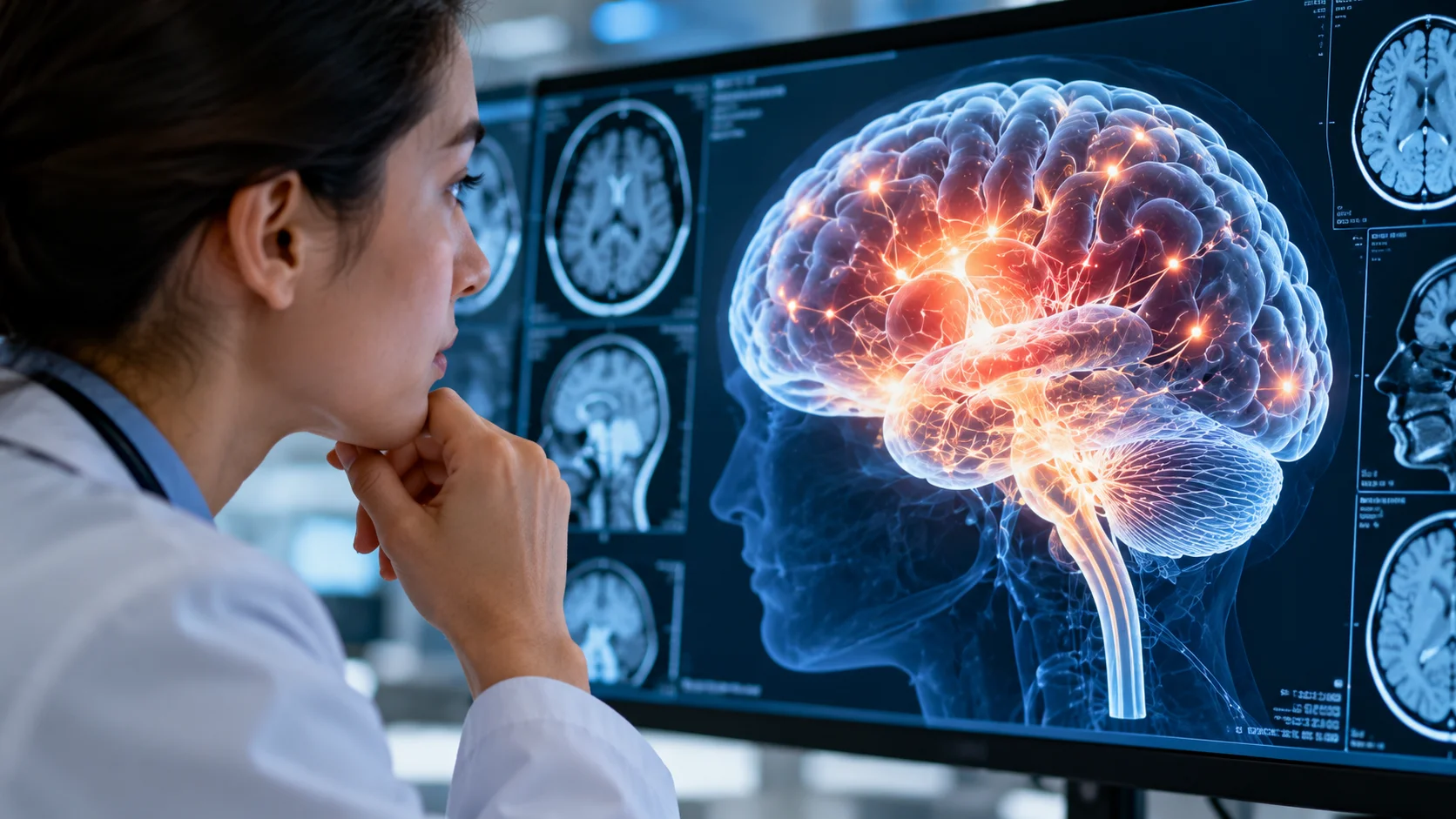
The brain is the body's command center, a roughly three-pound organ made up of tens of billions of nerve cells, or neurons, constantly exchanging electrical and chemical signals.
Three Main Regions
The brain is broadly divided into three parts. The cerebrum, the largest region, handles conscious thought, memory, language, and voluntary movement, and is itself split into two hemispheres and four lobes, each with somewhat specialized roles. The cerebellum, tucked underneath, fine-tunes balance, coordination, and precise movement. The brainstem, at the base, connects the brain to the spinal cord and quietly manages functions essential to survival — breathing, heart rate, and blood pressure — without any conscious effort.
How Neurons Communicate
Neurons pass information to one another across tiny gaps called synapses. When one neuron fires, it releases chemical messengers called neurotransmitters that cross the gap and trigger — or sometimes suppress — activity in the next neuron. A single neuron can connect to thousands of others, creating networks so dense that the brain contains an estimated 100 trillion connections.
Protected on Every Level
The brain floats in a cushioning layer of cerebrospinal fluid, encased within three protective membranes, and surrounded by the skull. A selective barrier between the bloodstream and brain tissue, called the blood-brain barrier, filters what can reach brain cells, keeping out many toxins and pathogens while still allowing oxygen, glucose, and other essentials through.
An Energy-Hungry Organ
Despite making up only about 2% of body weight, the brain consumes roughly 20% of the body's energy at rest, almost entirely from glucose. It never fully switches off, even during sleep — different regions stay active, cycling through processes involved in memory consolidation and physical restoration.
Constantly Rewiring
The brain retains a degree of adaptability throughout life, known as neuroplasticity. Learning a new skill or repeated practice can physically strengthen certain neural connections while others weaken from disuse, meaning the brain's internal wiring is never entirely fixed.