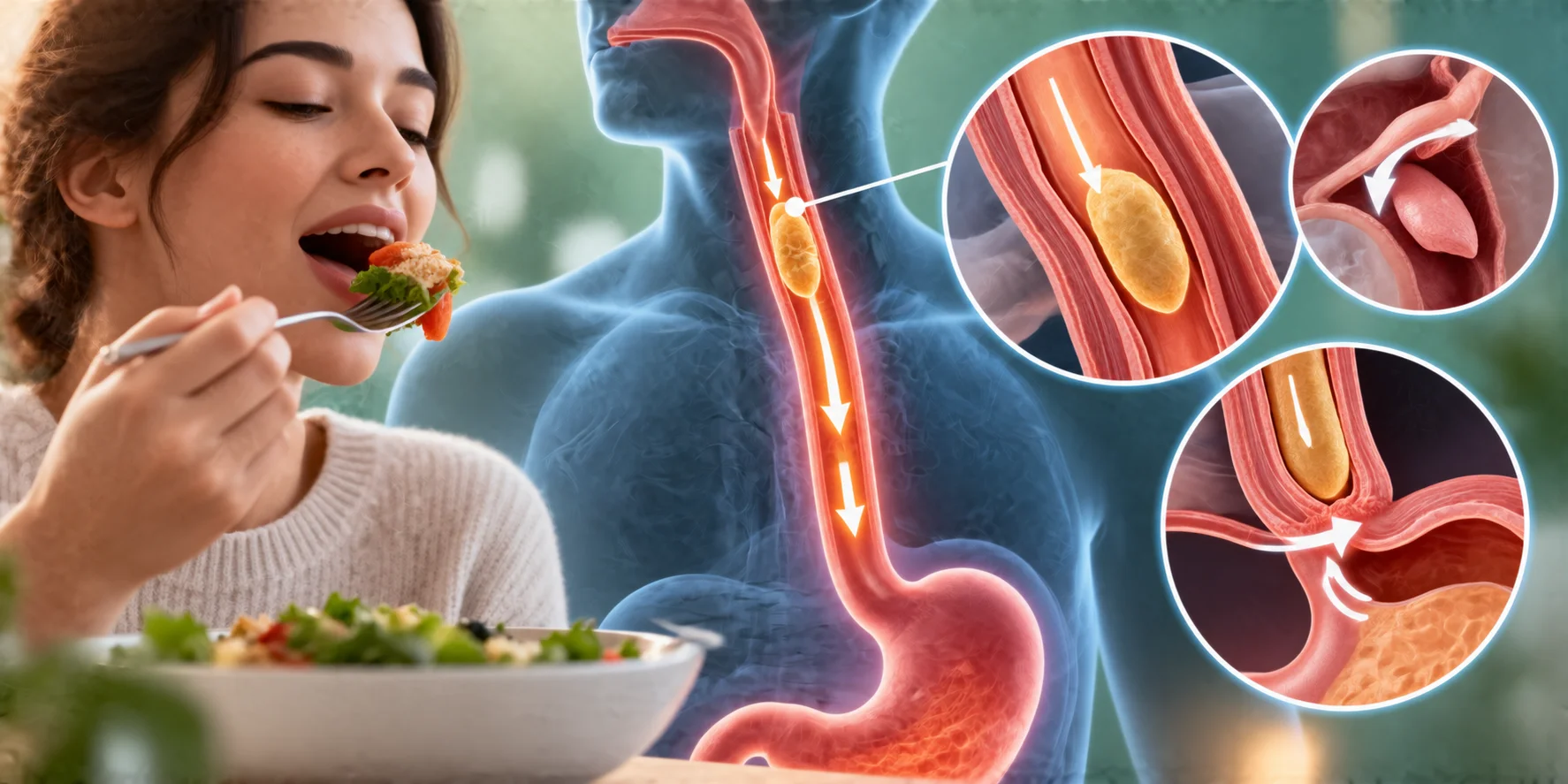
The esophagus is a muscular tube, roughly ten inches long, connecting the throat to the stomach. Its sole function is to transport food and liquid from the mouth to the stomach, but it does so through an active, coordinated process rather than simply letting gravity do the work.
Not Just a Passive Tube
Although it might seem like food simply falls down the esophagus, the tube's walls are lined with muscle that performs wave-like contractions called peristalsis, squeezing food along its length. This is why a person can technically swallow and have food travel to the stomach even while lying down or upside down — muscular action, not gravity, drives the process.
Triggering the Swallow
Swallowing begins voluntarily, as the tongue pushes food toward the back of the throat. From that point, the process becomes automatic, controlled by a swallowing reflex. During this reflex, a small flap called the epiglottis folds down to cover the entrance to the windpipe, ensuring that food and liquid are directed into the esophagus rather than the airway.
Two Protective Valves
At each end of the esophagus is a ring of muscle called a sphincter. The upper esophageal sphincter opens briefly during swallowing and otherwise stays closed, preventing air from entering the digestive tract during breathing. The lower esophageal sphincter, where the esophagus meets the stomach, opens to let food pass through and then closes again, helping to keep stomach contents from moving back upward.
A Lined, Protected Surface
The inner lining of the esophagus is made of a tough, layered tissue designed to withstand the friction of food passing through, though it's considerably less resistant to acid than the stomach lining, which is why the lower sphincter's job in limiting backflow is important.
A Quick Journey
Once swallowing begins, food typically takes only a few seconds to travel the length of the esophagus and reach the stomach, one of the faster transit times of any stage in digestion.