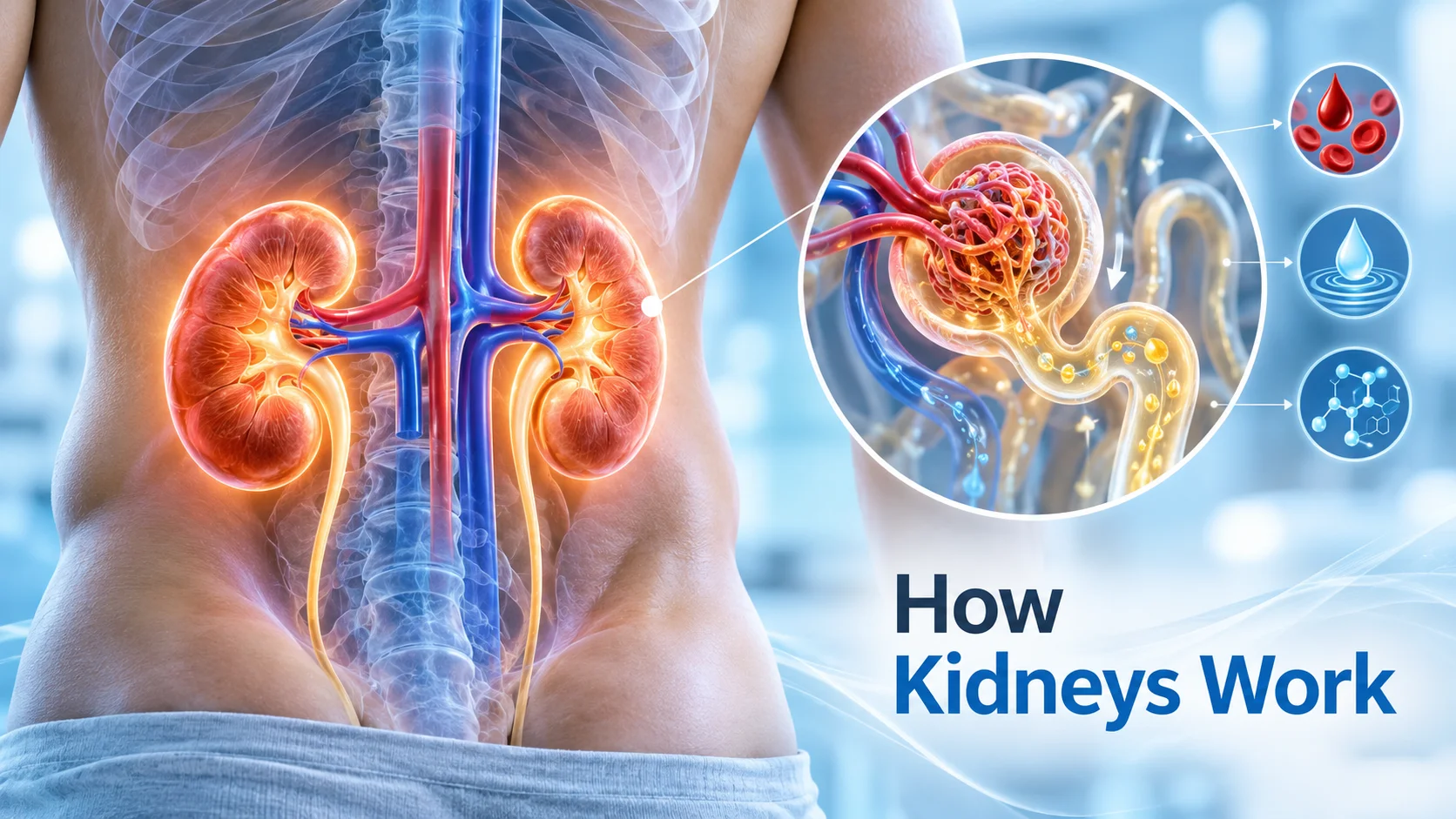
The kidneys are a pair of bean-shaped organs, each roughly the size of a fist, located toward the back of the abdomen, one on either side of the spine. Their primary role is filtering blood to remove waste and excess fluid, which leave the body as urine.
The Filtering Units
Each kidney contains about a million microscopic filtering units called nephrons. Blood entering a nephron passes through a small cluster of tiny blood vessels called a glomerulus, which filters out water, salts, and waste products while keeping larger components, like blood cells and most proteins, in circulation. The filtered fluid then travels through a long, winding tubule, where the kidney reclaims the water, glucose, and minerals the body still needs, leaving behind concentrated waste as urine.
Balancing the Body's Fluids
Beyond filtering, the kidneys constantly fine-tune the levels of sodium, potassium, and other electrolytes in the blood, along with the body's overall fluid balance. This balance affects blood pressure, nerve function, and muscle activity throughout the body.
More Than Filtration
The kidneys also produce hormones. One, erythropoietin, signals bone marrow to produce more red blood cells when oxygen levels are low. Another set of processes helps activate vitamin D into a form the body can use to absorb calcium. The kidneys also release an enzyme called renin, part of a hormone system that helps regulate blood pressure.
A Constant, High-Volume Job
Together, the kidneys filter the entire volume of blood in the body roughly 40 times a day, processing about 150 liters of fluid to produce just 1 to 2 liters of urine — the rest is reabsorbed back into the bloodstream.
Built-In Redundancy
A healthy person can function well with just one kidney, since a single kidney can adapt to handle a much larger share of the filtering workload, which is part of why kidney donation between living donors is possible.