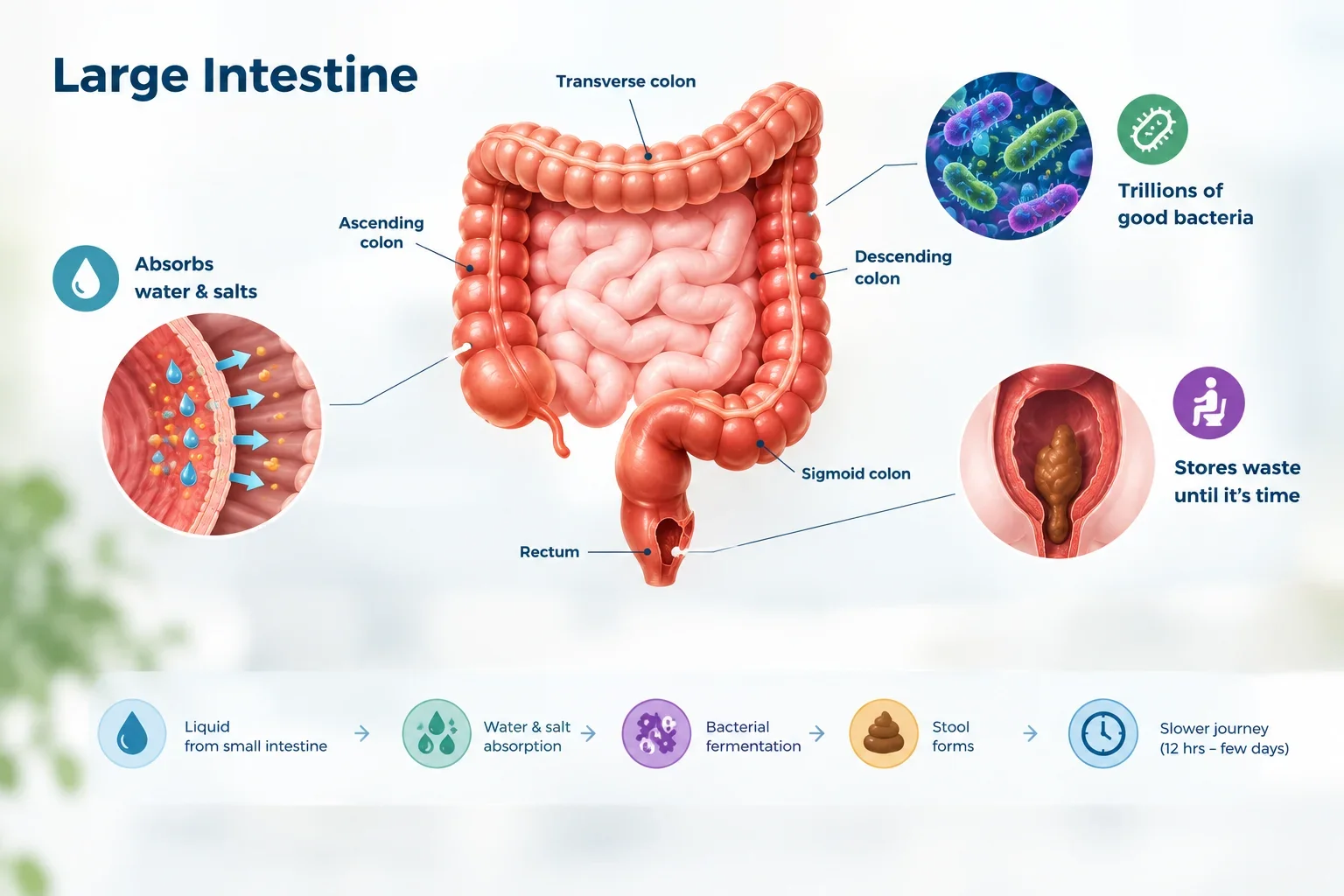
The large intestine, also called the colon, is a wide, roughly five-foot-long tube that forms the final section of the digestive tract, framing the small intestine on three sides of the abdomen. By the time material reaches it, most of the useful nutrients have already been absorbed, and its job shifts to reclaiming water and preparing waste for elimination.
Reclaiming Water and Salts
Material entering the large intestine from the small intestine is still largely liquid. As it moves through the colon, the intestinal lining absorbs much of the remaining water, along with certain salts, gradually thickening the material into the semi-solid form of stool.
Home to Trillions of Bacteria
The large intestine hosts an enormous and diverse community of bacteria, often called the gut microbiome. These bacteria break down certain fibers and other materials the small intestine couldn't digest, producing byproducts the body can use, including some vitamins, particularly vitamin K and several B vitamins.
Sections Along the Way
The colon is divided into several segments — the ascending, transverse, descending, and sigmoid colon — through which material travels in sequence, each segment continuing the process of water absorption and bacterial fermentation before reaching the rectum.
Storage and Elimination
The rectum, at the very end of the large intestine, serves as a holding area for stool until elimination. Stretch receptors in the rectal wall trigger the urge to have a bowel movement once it reaches a certain point of fullness, and a set of muscular sphincters provide voluntary control over the timing.
A Slower Journey
Movement through the large intestine is considerably slower than through the small intestine, generally taking anywhere from twelve hours to a few days, giving the resident bacteria and the intestinal lining time to complete their work before waste is eliminated.