The lungs are a pair of spongy, air-filled organs that sit in the chest, protected by the rib cage. Their essential task is gas exchange: pulling oxygen into the body and pushing carbon dioxide out.
The Journey of a Breath
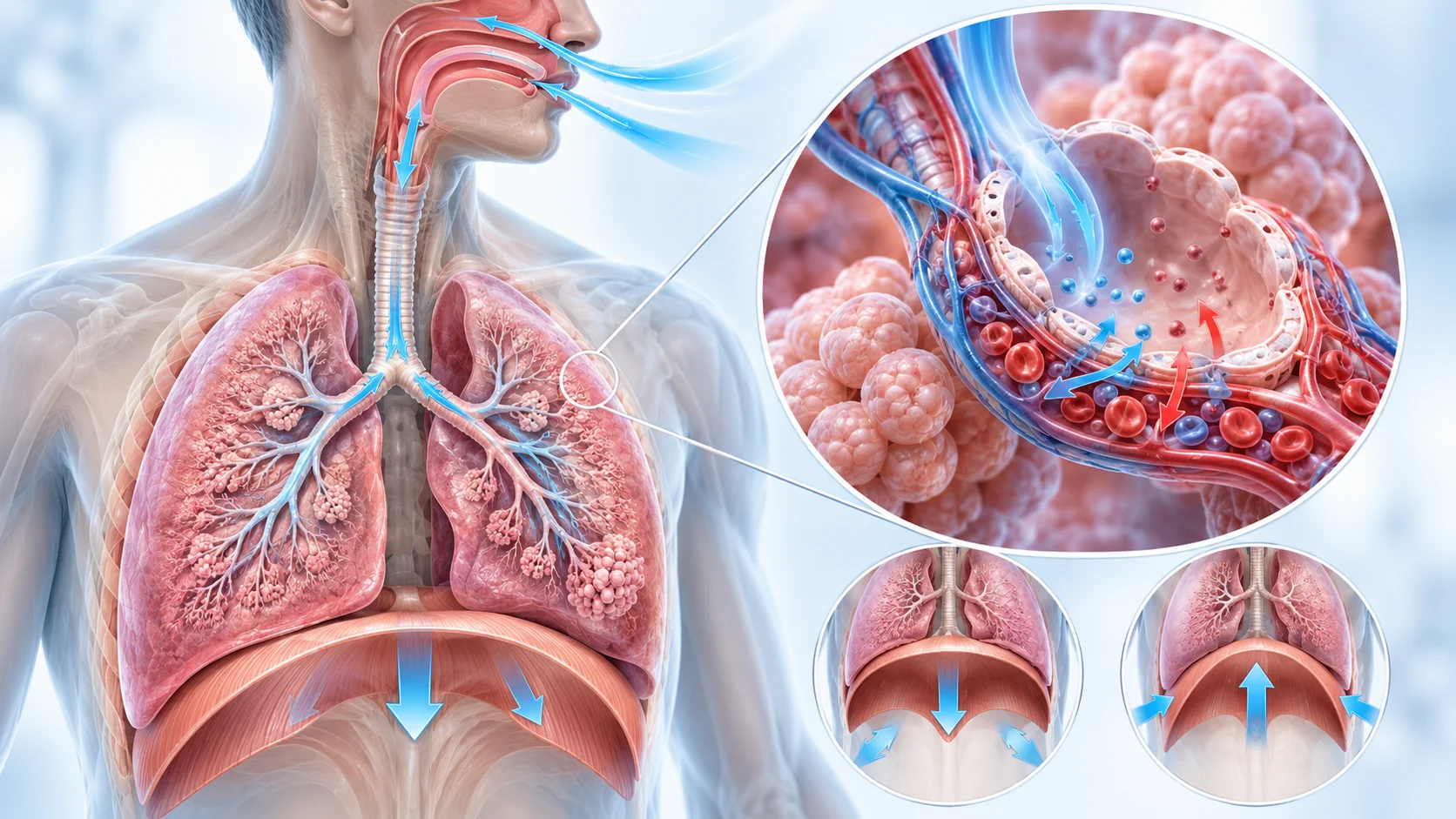
Air enters through the nose or mouth and travels down the trachea, which splits into two bronchi — one for each lung. Inside the lungs, these branch again and again into smaller airways called bronchioles, much like the branches of a tree, until they end in tiny clustered air sacs called alveoli. An adult's lungs contain roughly 300 to 500 million of these microscopic sacs.
Where the Real Work Happens
Each alveolus is wrapped in a fine mesh of capillaries, blood vessels so thin that oxygen and carbon dioxide can pass directly through their walls. Oxygen moves from the inhaled air into the bloodstream, while carbon dioxide, a waste product from the body's cells, moves the opposite way to be exhaled. This exchange happens continuously, tens of thousands of times a day.
The Muscle That Does the Pulling
The lungs have no muscle of their own to expand and contract. That work is done by the diaphragm, a dome-shaped muscle beneath the lungs, along with muscles between the ribs. When the diaphragm contracts and flattens, it creates space that draws air in. When it relaxes, air is pushed back out.
Two Lungs, Not Quite Twins
The right lung is slightly larger and divided into three sections, while the left lung has only two, making room for the heart, which sits slightly to the left of the chest's center.
Beyond Breathing
The lungs also help regulate the body's acid-base balance by controlling how much carbon dioxide is retained or released, and they filter small blood clots and other particles out of the bloodstream before it reaches the rest of the body. On average, a person breathes about 20,000 times a day without ever having to think about it.