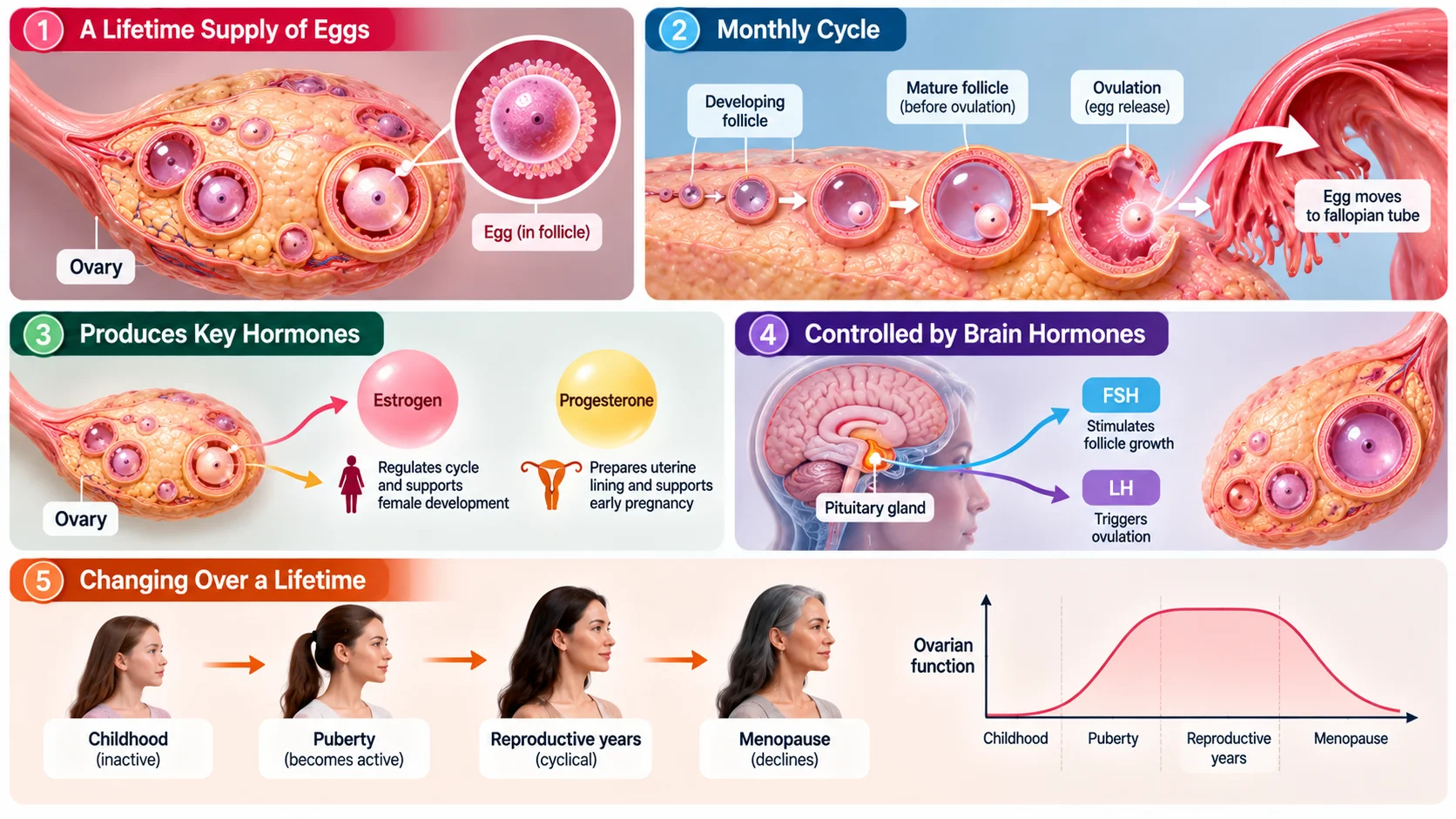
The ovaries are a pair of small, oval-shaped organs located on either side of the uterus, forming a central part of the female reproductive system. They serve two main roles: producing eggs and producing key reproductive hormones.
Home to a Lifetime Supply of Eggs
Unlike many other cells in the body, egg cells are not continuously produced throughout life. Instead, the ovaries contain a fixed number of immature eggs present from birth, housed within small structures called follicles. Over the course of a reproductive lifespan, a limited number of these eggs will mature and be released.
The Monthly Cycle
During each menstrual cycle, a small group of follicles begins to develop, though typically only one reaches full maturity. Around the midpoint of the cycle, this mature egg is released from the ovary in a process called ovulation, after which it travels into the fallopian tube.
Producing Hormones
Beyond producing eggs, the ovaries are a major source of the hormones estrogen and progesterone. Estrogen plays a role in regulating the menstrual cycle and supports the development of certain physical characteristics during puberty. Progesterone helps prepare the uterine lining for a potential pregnancy and supports early pregnancy if it occurs.
A Cycle Driven by the Brain
Ovarian activity doesn't happen in isolation — it's directed by hormones from the pituitary gland, specifically follicle-stimulating hormone and luteinizing hormone, which rise and fall in a coordinated pattern that drives the different phases of the menstrual cycle, from follicle development through ovulation.
Changing Activity Over Time
Ovarian function follows a distinct pattern across a lifetime, becoming active at puberty, operating in a cyclical pattern through the reproductive years, and gradually winding down later in life as the supply of remaining eggs and hormone production decline.