The salivary glands are a set of glands located around the mouth and jaw that produce saliva, the fluid that plays a surprisingly active role in the very first stage of digestion.
Three Major Pairs
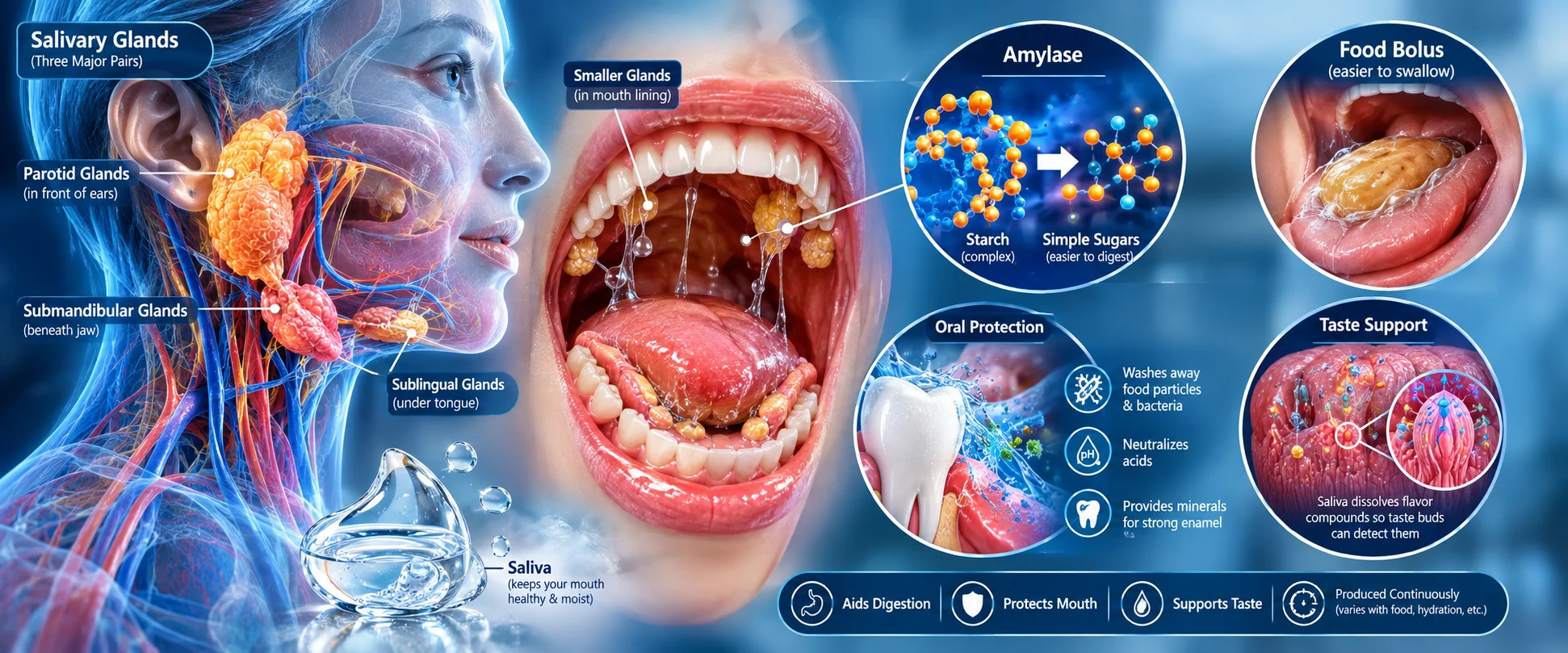
There are three main pairs of salivary glands. The parotid glands, the largest, sit in front of the ears. The submandibular glands are located beneath the jaw. The sublingual glands sit under the tongue. Together with numerous smaller glands scattered throughout the mouth's lining, they continuously produce saliva, with output increasing sharply at the sight, smell, or taste of food.
Beginning Digestion Early
Saliva contains an enzyme called amylase, which begins breaking down starches into simpler sugars while food is still being chewed, meaning digestion starts in the mouth rather than the stomach. This is why foods high in starch can begin to taste slightly sweet the longer they're chewed.
Making Food Easier to Swallow
Saliva moistens food and, combined with chewing, helps form it into a soft, cohesive mass called a bolus, which can be swallowed smoothly and safely. Without adequate saliva, swallowing becomes considerably more difficult.
Protecting the Mouth
Saliva also serves a protective role, helping to wash away food particles and bacteria, neutralizing acids produced by bacteria in the mouth, and providing minerals that help maintain the strength of tooth enamel. It also contains antibacterial compounds that help limit the growth of harmful microorganisms.
Supporting Taste
Saliva plays a supporting role in the sense of taste as well, since taste buds can only detect flavor compounds when they're dissolved in liquid, meaning a dry tongue has a notably reduced ability to perceive taste.
Continuous, Variable Production
The salivary glands produce saliva constantly, even without food present, at a slower baseline rate, adjusting output up or down throughout the day based on food intake, hydration, and other factors.