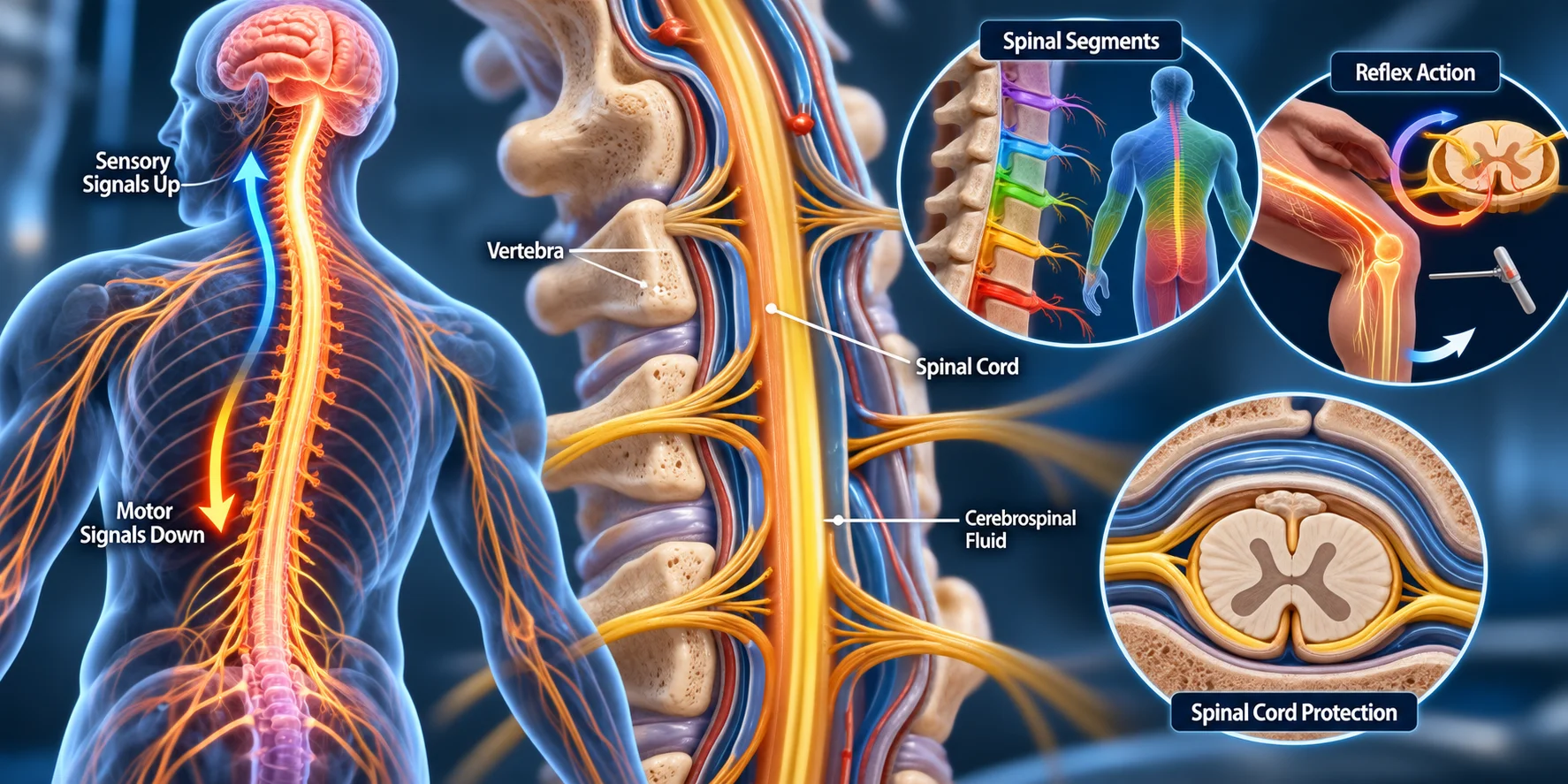
The spinal cord is a long, cylindrical bundle of nerve tissue that runs from the base of the brain down through the spinal column, protected by the surrounding vertebrae. It serves as the primary communication pathway between the brain and the rest of the body.
The Main Signal Highway
Nearly all information traveling between the brain and the body passes through the spinal cord. Sensory information — touch, temperature, pain, and the body's sense of position — travels up the spinal cord toward the brain, while motor commands directing muscle movement travel down from the brain to the body. This two-way traffic happens continuously and largely outside conscious awareness.
Organized Into Segments
The spinal cord is organized into segments, each connected to a specific pair of spinal nerves that branch out to particular regions of the body. This segmented organization is why damage at a specific level of the spinal cord tends to affect sensation and movement in predictable areas of the body below that point.
Reflexes Without the Brain
Not all spinal cord activity requires input from the brain. Certain reflexes, like the automatic withdrawal of a hand from a hot surface, are processed directly within the spinal cord itself, through a rapid circuit involving sensory nerves, connecting neurons, and motor nerves. This allows an extremely fast protective response, faster than if the signal had to travel all the way to the brain and back.
Protected by Bone and Fluid
The spinal cord is encased within the bony vertebrae of the spine, and further cushioned by the same protective fluid, cerebrospinal fluid, that surrounds the brain, along with protective membranes. This layered protection reflects how critical the spinal cord is to overall function.
A Central, Continuous Role
Every voluntary movement, and most involuntary bodily processes controlled by the nervous system, depend on the spinal cord's ability to relay signals accurately and quickly, making it one of the most functionally essential structures in the entire body.