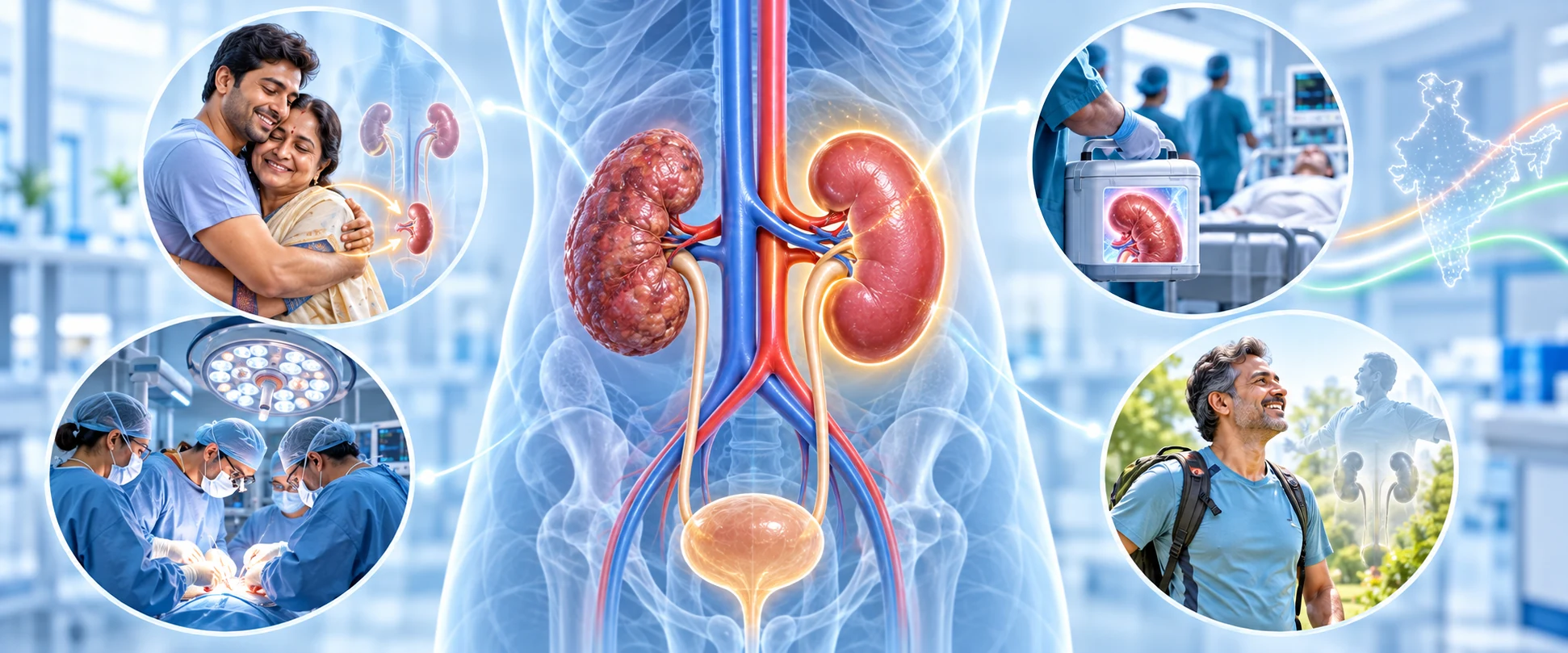
A kidney transplant is the best treatment for most people with kidney failure. Compared with dialysis, it gives patients a longer life, a better quality of life and lower long-term costs. India now performs more organ transplants than ever before. Yet only a small fraction of the people who need a new kidney will ever receive one.
A Growing Need
Chronic kidney disease is rising across India, driven largely by diabetes and high blood pressure. When the kidneys fail completely, a patient needs either dialysis for life or a transplant. Estimates suggest India requires approximately 1.75 to 2 lakh kidneys annually, yet only 13,476 kidney transplants were performed in 2024. In other words, fewer than one in ten patients who need a kidney get one each year. Many of the rest depend on dialysis, which is costly and not always accessible, and many die waiting.
Record Numbers, but Mostly from Living Donors
Transplant activity has grown steadily. India recorded 20,138 organ transplants in 2025, its highest-ever annual total, according to the NOTTO annual report 2025-26. This is four times the 4,990 transplants of 2013 and 6.5 percent more than in 2024. Kidneys make up the large majority of these. Globally, India ranks first in living donor transplants, third in total transplants, and 68th in deceased donor transplants.
That last figure reveals the central problem. Almost all kidney transplants in India come from living donors, usually a family member. In 2024, NOTTO data show 11,558 living donor kidney transplants compared with 1,918 deceased donor kidney transplants.
The Deceased Donation Gap
In countries with strong transplant systems, organs from people who have died, usually after brain stem death, form a large share of transplants. In India, the deceased donor rate remains 0.77 per million population, contributing to only 15% of transplants. By comparison, Spain, which has the highest rate globally, reaches 48 per million.
The potential is large. NOTTO has pointed to the 1.73 lakh road accident deaths in India each year, many of which could lead to life-saving donations if brain stem death certification and family consent processes improve. Common barriers include low awareness of brain stem death, religious and cultural misconceptions, reluctance to discuss donation with grieving families and too few hospitals equipped to identify and certify potential donors.
Progress is uneven across the country. Southern and western states lead: in 2025, Tamil Nadu led deceased organ donation with 266 donors, followed by Maharashtra with 205, Telangana with 198, Karnataka with 154 and Kerala with 152. Meanwhile, several states and Union Territories reported no deceased organ donation activity in 2024, including large parts of the North-East (except Manipur), Uttarakhand, Jharkhand, Jammu & Kashmir, Ladakh and the Andaman and Nicobar Islands.
There are encouraging signs. Deceased donor organ transplants rose from just 837 in 2013 to 3,526 in 2025, more than a fourfold increase.
A Striking Gender Gap
Kidney transplantation in India shows a marked imbalance between men and women. Between 2019 and 2023, women made up only 30% of living donor kidney recipients, even though they represented 66.2% of donors. In practice, wives and mothers often donate kidneys to husbands and sons, while women with kidney failure are less likely to receive one. There has been some improvement, with the share of female recipients rising from 28% in 2019 to 36.8% in 2023.
Access and Cost
Transplant services are concentrated in private hospitals and large cities. Of the 682 kidney transplant centres registered with NOTTO, 87% are in the private sector and only 13% in government hospitals.
Cost is a major barrier. Transplants in government hospitals can cost INR 1.5 to 3 lakh, often heavily subsidised, while private hospitals usually charge between INR 5 and 12 lakh. Ayushman Bharat (PM-JAY) covers transplant surgery and hospitalisation up to Rs 5 lakh per family per year at empanelled hospitals, but it typically does not cover lifelong immunosuppressive medicines, which cost around Rs 6,000 to 16,000 a month. For many families, these ongoing costs are as challenging as the surgery itself.
Government capacity is expanding. Besides AIIMS New Delhi, 10 newly established AIIMS now perform kidney transplants. This should reduce dependence on a few metropolitan centres.
The Legal Framework
Organ donation and transplantation in India are governed by the Transplantation of Human Organs and Tissues Act (THOTA). Close relatives can donate to one another after approval by the hospital's authorisation committee. Donation by an unrelated living person requires approval from a state-level authorisation committee to prevent organ trafficking, and buying or selling organs is a criminal offence.
The national network of NOTTO, along with regional (ROTTO) and state (SOTTO) organisations, coordinates deceased donation and organ allocation. This network now covers 31 states and Union Territories, improving coordination between hospitals. In 2026, NOTTO launched a new digital platform, mobile app and national guidelines aimed at improving transparency, coordination and efficiency.
Swap Transplants: An Indian Success Story
Many patients have a willing family donor whose blood group or tissue type does not match. Swap, or paired, transplants offer a solution. If a patient's donor is incompatible with them but compatible with another recipient whose donor matches the first patient, the two pairs can exchange kidneys. India has become one of the world's leading performers of swap transplants, and some centres now run larger multi-pair exchanges.
What Needs to Change
Experts point to several priorities for closing the gap:
- Strengthening deceased donation, by training ICU teams to identify brain stem death, appointing transplant coordinators in more hospitals and supporting families through the consent process
- Raising public awareness so that people discuss their wishes with family and pledge to donate
- Expanding government transplant centres beyond major cities
- Making post-transplant medicines affordable, including through insurance and state schemes
- Addressing gender inequity, so that women with kidney failure have equal access to transplants
- Preventing kidney disease in the first place, through better control of diabetes and blood pressure and earlier screening of people at risk
- The Bottom Line
India has made remarkable progress in kidney transplantation, with record numbers of transplants, growing deceased donation and expanding public sector capacity. But for the hundreds of thousands of Indians with kidney failure, the gap between need and supply remains vast. Closing it will depend above all on more families choosing deceased organ donation, and on a health system equipped to turn that choice into a second chance at life.