When people think about vital organs, the heart, brain and lungs usually come first. The intestines rarely get the same attention, yet almost every nutrient that keeps the body alive passes through them. They digest food, absorb what the body needs, house a large share of the immune system and communicate constantly with the brain.
Two Intestines, One Long Journey
The intestines form a continuous tube from the stomach to the anus. They are divided into two main parts, the small intestine and the large intestine, and each has a different job.
The Small Intestine
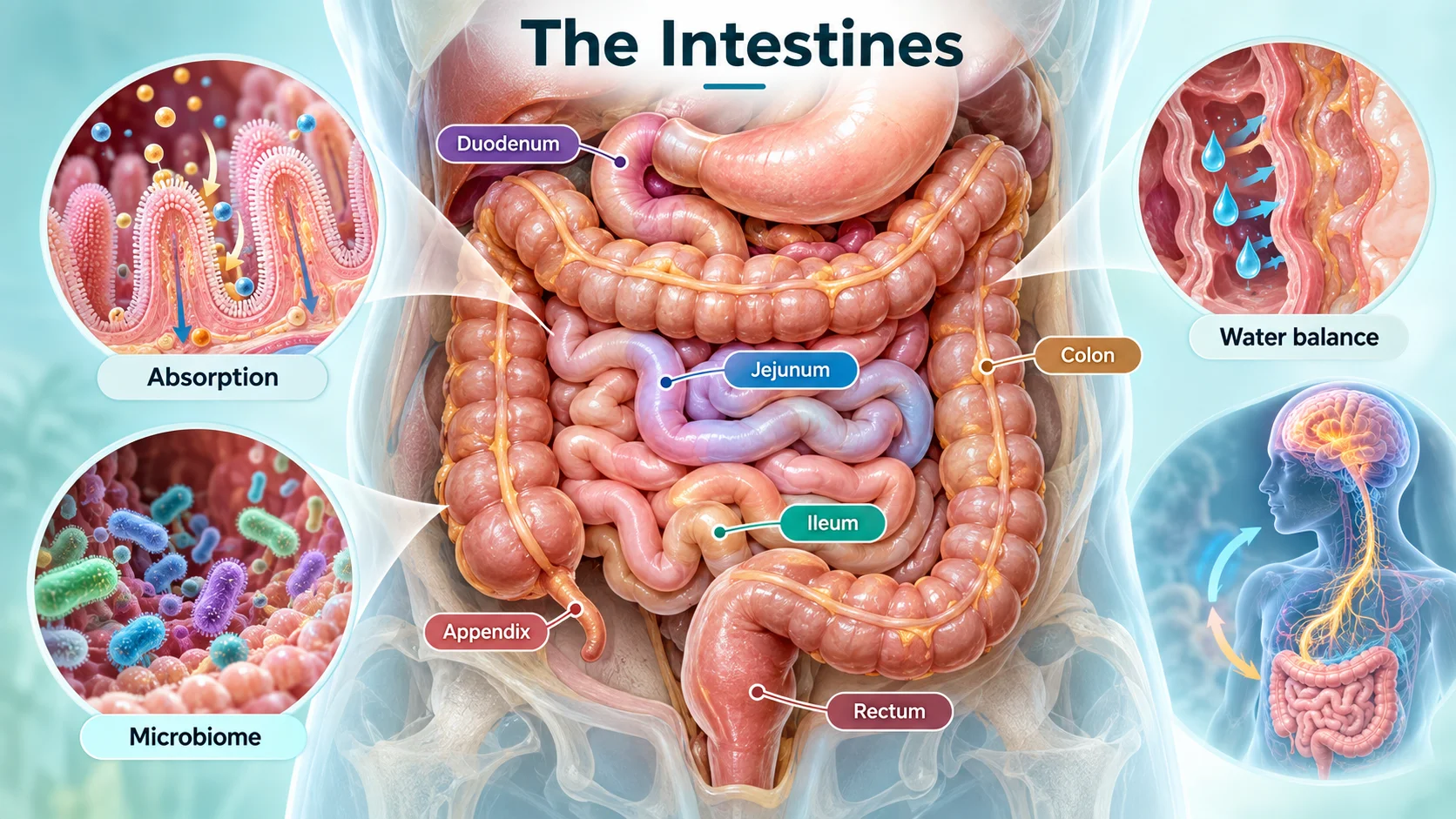
Despite its name, the small intestine is the longer of the two, measuring roughly 6 to 7 metres in an adult. It is called "small" because it is narrower. Most digestion and nearly all nutrient absorption happen here. It has three sections.
The duodenum is the first and shortest section, about 25 cm long, and sits just after the stomach. It receives partly digested food along with bile from the liver and gallbladder and digestive enzymes from the pancreas. Together these break down fats, proteins and carbohydrates. The duodenum is also where much of the body's iron is absorbed.
The jejunum is the middle section. It is the main site for absorbing sugars, amino acids and fatty acids. Its inner lining is folded and covered in tiny finger-like projections called villi, which are themselves covered in microvilli. This greatly increases the surface area available for absorption.
The ileum is the final and longest section. It absorbs whatever nutrients remain, and it has two jobs no other part of the gut can do: absorbing vitamin B12 and reabsorbing bile salts so the liver can reuse them. The ileum also contains clusters of immune tissue called Peyer's patches, which monitor the gut contents for harmful microbes.
The Large Intestine
The large intestine is about 1.5 metres long and wider than the small intestine. By the time food reaches it, most nutrients have been absorbed. Its main work is handling what is left.
The caecum is a pouch where the small intestine meets the large intestine. The appendix hangs from it and contains immune tissue.
The colon makes up most of the large intestine. It rises on the right side of the abdomen (ascending colon), crosses the upper abdomen (transverse colon), runs down the left side (descending colon) and curves into an S-shape (sigmoid colon). The colon absorbs water and electrolytes, turning liquid waste into formed stool. It is also home to trillions of bacteria that ferment dietary fibre into short-chain fatty acids, which nourish the cells of the colon lining. These bacteria also produce vitamin K and some B vitamins.
The rectum and anal canal store stool and control its release from the body.
Why the Intestines Cannot Be Ignored
They feed the entire body. Every cell depends on nutrients that the intestines absorb. When the intestines are damaged, as in coeliac disease or Crohn's disease, deficiencies can follow even when a person eats well. These can include iron, B12, folate and fat-soluble vitamins.
They are a major part of the immune system. A large proportion of the body's immune cells are found in and around the gut. The intestinal lining acts as a barrier that lets nutrients in while keeping harmful microbes and toxins out.
They communicate with the brain. The gut has its own extensive nervous system, sometimes called the "second brain." It is linked to the brain through the vagus nerve and chemical signals. Most of the body's serotonin is produced in the gut. Researchers are actively studying how gut health relates to mood, stress and some neurological conditions.
Their microbiome matters. The bacteria in the colon influence digestion, immunity and metabolism. Diet, antibiotics and illness can all shift this balance.
Serious diseases can develop quietly. Colorectal cancer is one of the most common cancers worldwide, and it often begins as polyps that cause no symptoms. Screening can find and remove these polyps before they turn cancerous. Inflammatory bowel disease, irritable bowel syndrome and coeliac disease can also go undiagnosed for years.
Warning Signs to Take Seriously
See a doctor if you notice any of the following:
- blood in the stool or black, tarry stools
- a change in bowel habits that lasts more than a few weeks
- unexplained weight loss
- persistent abdominal pain or bloating
- unexplained anaemia or fatigue
People reaching the age recommended for colorectal screening in their country should discuss it with their doctor. Those with a family history of bowel cancer or inflammatory bowel disease should ask whether they need screening earlier.
Looking After Your Intestines
A diet rich in fibre from vegetables, fruits, legumes and whole grains supports both regular digestion and healthy gut bacteria. Other habits that help include drinking enough water, staying physically active, limiting processed and red meat, avoiding unnecessary antibiotics and not smoking.
The intestines work quietly, and it is easy to forget them until something goes wrong. Paying attention to them, and to the signals they send, is one of the most practical things a person can do for long-term health.