

When couples begin fertility treatment, their primary concern is naturally simple: “Will this treatment help us have a baby?
As fertility specialists, however, we have another responsibility that is equally important: ensuring that the treatment is medically appropriate, ethically sound, properly consented and legally compliant.
Modern reproductive medicine involves much more than ovarian stimulation and embryo transfer. IVF may involve donor gametes, embryo cryopreservation, genetic testing, surgical sperm retrieval and, in selected circumstances, surrogacy.
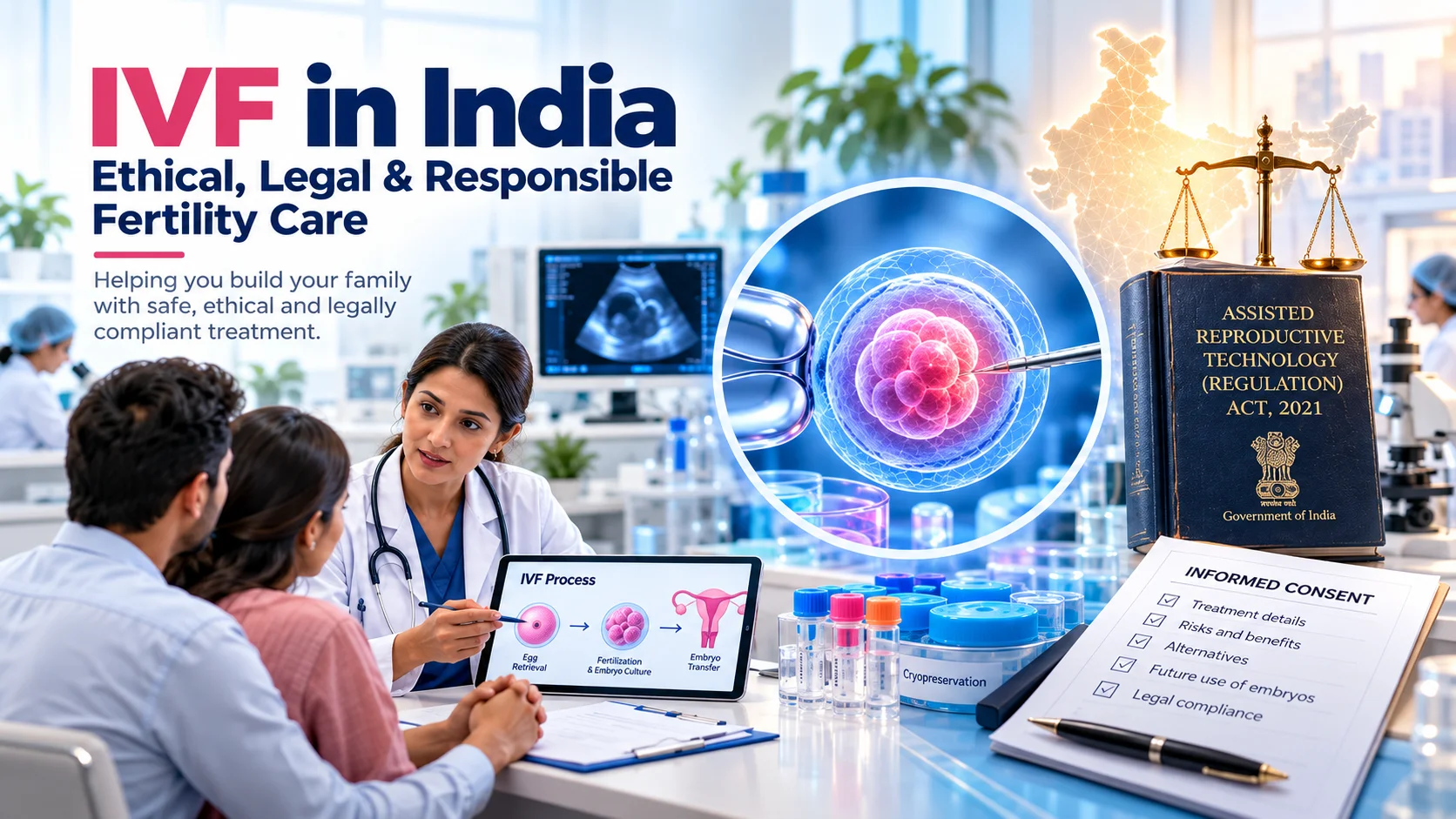
India has therefore developed a specific legal framework to regulate assisted reproductive technology.
For doctors, understanding this framework is not merely a legal formality. It is an important part of responsible fertility practice.
⸻
The ART Act: An important milestone in Indian fertility care
The Assisted Reproductive Technology (Regulation) Act, 2021 provides a central regulatory framework for assisted reproductive technology clinics and ART banks in India. The Act came into force on 25 January 2022.
It was introduced to regulate ART services, promote safe and ethical practice, prevent misuse of reproductive technologies and establish standards for clinics and ART banks.
For a fertility specialist, this means that IVF practice is not simply about having the medical expertise to perform a procedure.
The clinic, laboratory, ART bank, documentation and treatment pathway must also operate within the regulatory framework.
1. Consent is much more than obtaining a signature
One of the most important aspects of fertility treatment is informed consent.
Before treatment, patients should understand:
What treatment is being proposed
Why it is being recommended
Expected benefits
Possible risks and complications
Available alternatives
Possibility of treatment failure
What happens to gametes and embryos
Cryopreservation and future use
Donor involvement, when applicable
Relevant decisions concerning stored reproductive material
In fertility medicine, consent can become particularly complex because treatment may involve two individuals, gametes, embryos and decisions that can have implications years into the future.
As doctors, we should therefore think of consent as a conversation rather than a form.
A signed consent document is important, but genuine informed consent comes from ensuring that the patient actually understands the treatment.
2. Embryo and gamete documentation is extremely important
IVF creates a unique situation in medicine: biological material belonging to patients may remain outside the body and cryopreserved for extended periods.
This makes accurate identification and documentation essential.
Records should appropriately document:
Patient identity
Source of gametes
Oocyte retrieval
Fertilisation
Embryo development
Cryopreservation
Embryo transfer
Storage
Relevant patient decisions and consents
From a doctor’s perspective, good documentation is not simply about protecting the doctor.
It protects the patient and ensures continuity of care.
3. Donor gametes need a regulated pathway
Donor sperm and donor oocytes can be an important option for patients who cannot use their own gametes.
However, donor treatment should not be approached as an informal arrangement.
The ART Act provides for ART banks to undertake functions including donor screening and the collection, screening and storage of semen and provision of oocyte donors.
As fertility specialists, we should ensure that donor treatment takes place through the appropriate regulated pathway rather than through private or undocumented arrangements.
4. PGT requires careful counselling
Preimplantation genetic testing has become an important part of modern reproductive medicine.
However, patients should understand what genetic testing can and cannot tell us.
Before undertaking PGT, appropriate counselling should address:
The indication for testing
What is being tested
Limitations of the test
Possible results
Possibility of inconclusive or abnormal results
The implications for embryo selection
Whether confirmatory prenatal testing may be appropriate
Most importantly:
No genetic test can guarantee the birth of a completely healthy child.
Our responsibility is to communicate the benefits and limitations honestly.
5. Surrogacy is governed by a separate law
Surrogacy is not simply another IVF procedure.
It is governed by the Surrogacy (Regulation) Act, 2021, which establishes a separate regulatory framework.
The law provides for regulated surrogacy and prohibits commercial surrogacy It defines altruistic surrogacy and establishes requirements involving intending parents, surrogate mothers, clinics and regulatory authorities.
The law also contains restrictions concerning advertising, exploitation, importation of embryos or gametes for surrogacy and sex selection in surrogacy.
6. Confidentiality matters greatly in fertility medicine
Infertility treatment involves some of the most personal information a patient may share with a doctor.
This can include:
Semen analysis
Sexual history
Previous pregnancies
Previous abortions
Donor conception
Genetic test results
Embryo information
Previous IVF failures
Fertility preservation
Treatment outcomes
Such information deserves appropriate confidentiality and professional discretion.
Even apparently simple situations—such as discussing treatment details with relatives or other people accompanying the patient—should be handled appropriately.
A fertility clinic should be a place where patients feel medically and emotionally safe.
7. Documentation is one of the doctor’s strongest safeguards
If something important happened, document it.
This includes:
Counselling
Treatment decisions
Important risks discussed
Consent
Changes in treatment plans
Embryo-related decisions
Complications
Referrals
Important laboratory results
Significant communication with patients
Good documentation helps the next doctor understand what happened.
It also helps the patient understand their own treatment journey.
And if a dispute ever arises, contemporaneous medical records can become extremely important.
8. The law should support good medicine—not replace it
It is easy to think about legal compliance as a collection of restrictions.
The legal framework exists alongside medical ethics and professional responsibility.
A fertility specialist has to balance:
Clinical science
Patient autonomy
Informed consent
Confidentiality
Documentation
Ethics
Legal compliance
None of these can be ignored.
Final message-
As doctors, our responsibility does not end when an embryo is transferred.
It begins much earlier—with appropriate counselling, informed consent, correct documentation and legally compliant treatment.
And it continues throughout the patient’s fertility journey.
The goal of reproductive medicine should not simply be to help patients become parents. It should be to help them become parents through treatment that is scientifically sound, ethically responsible, patient-centred and legally compliant.