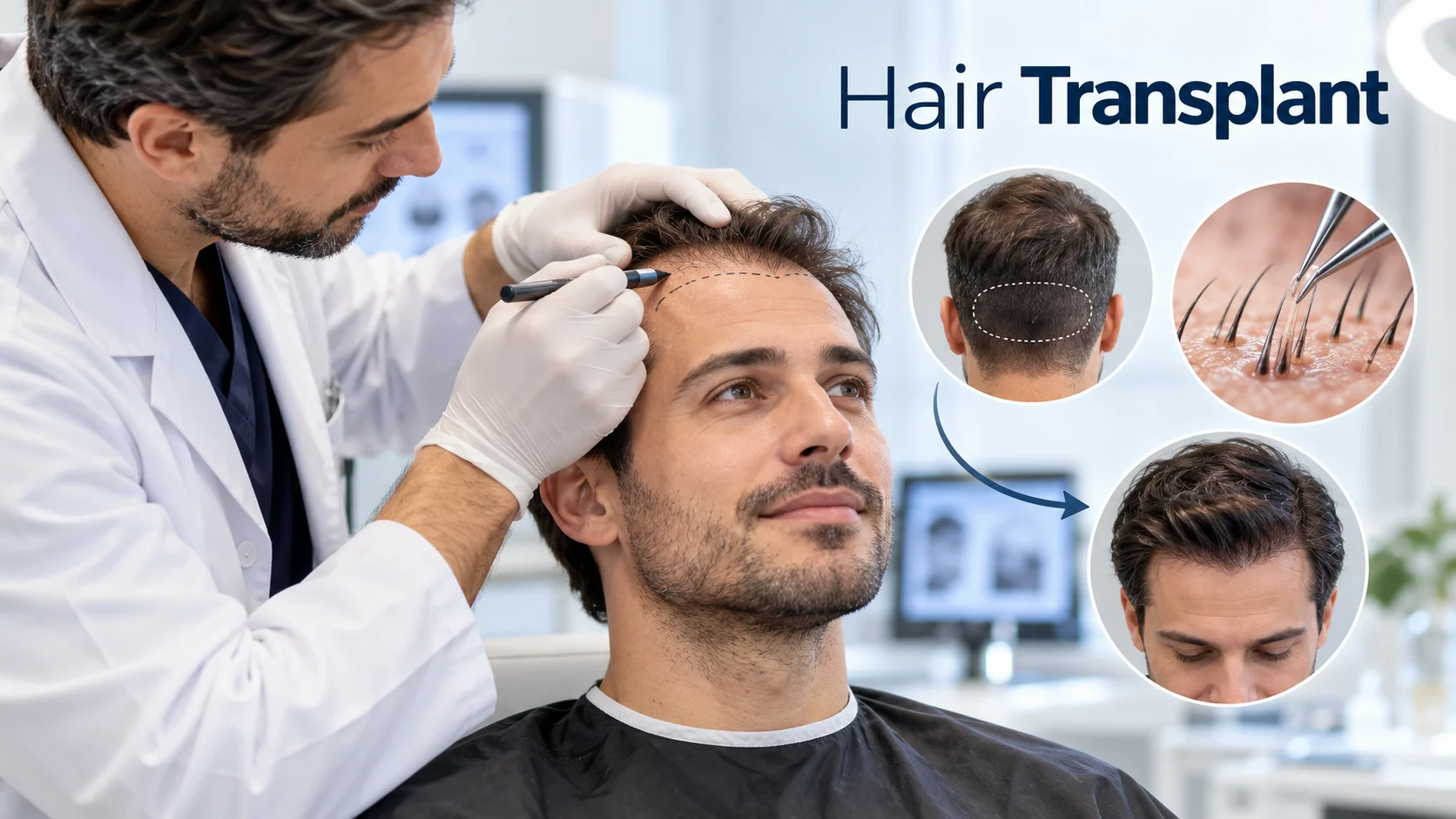
A hair transplant is a surgical procedure that moves healthy hair follicles from areas of the scalp where hair is permanent to areas that are thinning or bald. When performed properly by an experienced surgeon, it can provide natural-looking and long-lasting results.
The procedure works on a principle known as donor dominance. Hair follicles at the back and sides of the scalp are generally genetically resistant to the hormone responsible for common pattern baldness. When these follicles are transplanted to the front or top of the scalp, they usually retain this resistance and continue growing.
It is important to understand that a hair transplant does not create new hair. It redistributes the hair you already have. Therefore, the amount and quality of healthy donor hair play a major role in determining what can be achieved.
Causes of Hair Loss
Hair transplants are most commonly used to treat androgenetic alopecia, also known as pattern hair loss. It is hereditary and influenced by dihydrotestosterone (DHT), which gradually shrinks hair follicles.
In Men
Male pattern hair loss usually appears as:
A receding hairline
Thinning at the temples
Hair loss at the crown
Progressive baldness over the top of the scalp
Doctors commonly assess male hair loss using the Norwood Scale.
In Women
Female pattern hair loss usually presents as:
Diffuse thinning across the top of the scalp
Gradual reduction in hair density
A relatively preserved frontal hairline
Doctors may use the Ludwig or Savin Scale to assess female pattern hair loss.
Other Causes of Hair Loss
Hair loss may also be caused by:
Thyroid disorders
Iron deficiency
Severe stress or illness
Telogen effluvium
Alopecia areata
Certain medicines
Tight hairstyles causing traction alopecia
Many of these conditions may be temporary or treatable without surgery, so obtaining the correct diagnosis is important before considering transplantation.
Who Is a Good Candidate?
You may be suitable for a hair transplant if you have:
Stable pattern hair loss that has not progressed rapidly during the last one or two years
Dense and healthy donor hair at the back or sides of the scalp
Good general health
No uncontrolled bleeding disorder, diabetes or heart condition
Realistic expectations regarding density and results
Hair loss caused by burns, injuries, scarring or previous surgery
Hair loss affecting areas such as the eyebrows or beard
When a Hair Transplant May Not Be Suitable
A transplant may not be recommended if you have:
Diffuse thinning throughout the scalp, including the donor area
Active alopecia areata
An unstable scarring hair condition
Hair loss caused by an untreated medical problem
Very early or rapidly progressing hair loss
An unclear future pattern of baldness, particularly in younger patients
Hair Transplant Techniques
The two main hair transplant techniques are FUT and FUE.
Both transplant follicular units, which are naturally occurring groups containing approximately one to four hairs.
The main difference is how the grafts are collected from the donor area.
1. Follicular Unit Transplantation — FUT
FUT is also known as the strip method.
A thin strip of scalp is removed from the back of the head. The strip is then divided under microscopes into individual grafts.
The donor area is closed using stitches.
2. Follicular Unit Extraction — FUE
FUE removes individual grafts directly from the donor area using a small punch, generally around 0.7–1 mm wide.
Instead of one linear scar, FUE usually leaves many very small dot-like scars distributed across the donor region.
FUT vs FUE
Feature | FUT | FUE |
|---|---|---|
Harvesting | Strip of scalp removed and divided into grafts | Individual grafts removed one by one |
Scarring | Fine linear scar | Small dot scars |
Short hairstyles | Scar may become visible | Usually better suited |
Grafts per session | Often allows larger sessions | May be limited by time and donor area |
Recovery | Stitches and greater tightness | Faster donor-area healing |
Shaving | Usually only strip area | Donor area often shaved |
Best suited for | Large sessions and good scalp laxity | Most patients, short hairstyles and body-hair procedures |
Other Hair Transplant Methods
Direct Hair Implantation — DHI
DHI is essentially a variation of FUE.
Grafts are placed using a pen-like implantation device that creates the recipient site and inserts the graft.
It can provide precise control over:
Angle
Direction
Placement
However, it is often more expensive than standard FUE.
Robotic FUE
Robotic FUE uses computer-guided technology to assist with selecting and extracting grafts.
Technology can assist the procedure, but the surgeon's experience remains extremely important, especially for:
Hairline design
Graft placement
Density planning
Direction of growth
Body Hair Transplant
Hair from areas such as the beard or chest may sometimes be used when scalp donor hair is insufficient.
Body hair is generally used as a supplement rather than as the primary donor source.
Marketing names differ considerably between clinics. Patients should ask exactly which harvesting and implantation techniques will actually be used.
Hair Transplant Procedure: Step by Step
A hair transplant is generally performed as a day-care procedure under local anaesthesia.
Most sessions take approximately 4–8 hours, depending on the number of grafts.
Patients usually return home on the same day.
Step 1: Consultation and Planning
The doctor:
Examines the scalp
Determines the cause of hair loss
Evaluates the pattern of thinning
Checks donor density
Reviews medical history
May request blood tests
Plans the hairline
Estimates the number of grafts required
Step 2: Preparation
The donor area and sometimes the recipient area are trimmed or shaved.
The planned hairline and transplant areas are marked.
Step 3: Anaesthesia
Local anaesthetic is injected into the donor and recipient areas.
The patient remains awake during the procedure.
Step 4: Graft Harvesting
Hair follicles are collected using either FUT or FUE.
The grafts are placed in a cooled storage solution to preserve them until implantation.
Step 5: Creating Recipient Sites
Tiny incisions are created in the areas receiving transplanted hair.
Their:
Angle
Direction
Position
Spacing
play an important role in determining how natural the final result looks.
Step 6: Implanting the Grafts
Hair grafts are carefully placed into the recipient sites.
Single-hair grafts are generally placed along the front of the hairline to create a softer, natural appearance.
Multi-hair grafts are positioned behind them to improve density.
Step 7: Aftercare Instructions
After the procedure, the donor area may be dressed.
Patients receive instructions regarding:
Sleeping
Washing
Medication
Physical activity
Follow-up appointments
Preparing for Hair Transplant Surgery
Before surgery, your doctor may recommend:
Stopping smoking temporarily
Avoiding alcohol around the surgery period
Informing the doctor about all medicines and supplements
Adjusting medicines that may affect bleeding, but only under medical supervision
Smoking and alcohol can interfere with healing.
Hair Transplant Recovery and Results
Complete results may take approximately 12–18 months.
Many patients can return to desk-based work within a few days.
However, transplanted hair normally goes through several stages before the final result becomes visible.
Time After Surgery | What You May Experience |
|---|---|
Days 1–3 | Mild pain, tightness, forehead swelling and small scabs |
Days 7–10 | Scabs begin falling off, redness improves and FUT stitches may be removed |
Weeks 2–8 | Transplanted hairs commonly shed; temporary shock loss may occur |
Months 3–4 | New hair begins growing |
Month 6 | Noticeable improvement becomes visible |
Months 12–18 | Hair becomes thicker and final density develops |
The shedding that occurs during the first few weeks is usually expected. The transplanted follicles remain beneath the skin and later begin producing new hair.
Aftercare Tips
After a transplant:
Sleep with your head slightly elevated during the first few nights.
Avoid scratching, touching or picking at the grafts.
Wash your hair according to your clinic's instructions.
Washing usually begins gently around day two or three.
Avoid intense exercise temporarily.
Avoid swimming until your surgeon allows it.
Protect the scalp from strong direct sunlight.
Avoid tight hats.
Take prescribed medicines exactly as directed.
Attend scheduled follow-up appointments.
How Long Do Hair Transplant Results Last?
Transplanted hair is generally considered permanent.
However, the patient's original non-transplanted hair may continue thinning over time.
Doctors may therefore recommend treatments such as:
Minoxidil
Finasteride
These treatments may help preserve existing hair.
Some patients may choose another transplant later to improve density or address additional hair loss.
Risks and Side Effects
Hair transplantation is generally safe when carried out by a qualified surgeon in a properly equipped medical facility.
However, like any surgical procedure, complications are possible.
Common and Usually Temporary Side Effects
Pain
Swelling
Bruising around the forehead or eyes
Scabbing
Redness
Itching
Temporary numbness
Folliculitis
Temporary shock loss
Less Common but More Serious Complications
Infection
Excessive bleeding
Poor graft survival
Patchy or thin growth
Unnatural-looking hairline
Visible scarring
Widened scars
Excessive harvesting of donor hair
Reactions to local anaesthesia
Over-harvesting can permanently reduce the density of the donor area.
Patients should contact their clinic promptly if they notice symptoms such as:
Increasing pain
Spreading redness
Pus
Fever
Worsening swelling
Hair Transplant Cost
The cost of hair transplantation varies significantly depending on factors such as:
City
Clinic
Surgeon experience
Technique
Number of grafts
Number of sessions
Some clinics charge per graft, while others charge for the complete session.
FUE and DHI are generally more expensive than FUT.
Because hair transplantation is usually considered a cosmetic treatment, health insurance generally does not cover it.
Coverage may sometimes apply when hair restoration is required after:
Burns
Trauma
Injury
Medical reconstruction
Always request a written quotation explaining:
Estimated number of grafts
Procedure cost
Medicines
Follow-up visits
Additional treatments
Whether PRP is included
Choosing a Hair Transplant Surgeon and Clinic
The surgeon's skill is usually more important than the marketing name of the technique.
Look for:
A qualified doctor
A dermatologist or plastic surgeon with hair-restoration experience
A surgeon who personally performs important surgical steps
A surgeon who personally designs the hairline
Before-and-after photographs of similar patients
Results photographed around 12 months after surgery
Honest estimates of donor supply
Realistic graft recommendations
Clear discussion about possible future sessions
A clean and properly equipped surgical facility
Appropriate emergency support
Warning Signs
Be cautious about clinics offering:
Extremely low prices
Guaranteed results
Very high graft numbers in one session
Aggressive sales tactics
Pressure to book immediately
Alternatives and Supporting Treatments
Surgery is not the only option for managing hair loss.
Several treatments may help slow hair loss or support transplant results.
Minoxidil
Minoxidil may:
Reduce hair loss
Stimulate hair growth
Be used by both men and women
Topical formulations are commonly used, while oral minoxidil may sometimes be prescribed under medical supervision.
Finasteride
Finasteride reduces DHT and can help slow male pattern hair loss.
It is a prescription medicine.
It should not be used by women who are pregnant or may become pregnant.
Platelet-Rich Plasma — PRP
PRP treatment involves injecting concentrated platelets from the patient's own blood into the scalp.
Evidence regarding its effectiveness is promising but remains mixed.
Low-Level Laser Therapy
Laser-based devices may benefit some patients with early-stage thinning.
Scalp Micropigmentation
Scalp micropigmentation uses tattoo-style pigmentation to create the appearance of:
Closely shaved hair
Improved scalp coverage
Greater visual density
Hair Systems and Wigs
Hair systems and wigs provide an immediate, non-surgical alternative.
Medicines and treatments can have side effects and are not appropriate for everyone. They should be used under professional medical guidance.
Frequently Asked Questions
Is a Hair Transplant Painful?
Local anaesthetic injections may cause brief discomfort.
After the anaesthetic begins working, most patients experience very little discomfort during the procedure.
Mild soreness or tightness can occur for several days afterward.
How Many Grafts Will I Need?
The number of grafts depends on:
Size of the bald or thinning area
Desired density
Hair characteristics
Available donor hair
A small hairline restoration may require significantly fewer grafts than covering the complete top of the scalp.
Your surgeon should explain the expected graft requirement during consultation.
Can Women Have a Hair Transplant?
Yes.
Women may be suitable candidates when they have:
A healthy and stable donor area
A suitable pattern of hair loss
However, female hair loss often requires careful investigation because it may be associated with:
Hormonal conditions
Thyroid problems
Nutritional deficiencies
Will a Hair Transplant Look Natural?
Modern hair transplantation can produce very natural-looking results when:
The hairline is designed appropriately
Grafts are positioned correctly
Natural growth angles are followed
Individual hair grafts are used at the front
Can I Have More Than One Hair Transplant?
Yes.
Some patients undergo another procedure to:
Increase density
Treat further hair loss
Improve previous results
Additional procedures depend on the amount of healthy donor hair still available.
Final Thoughts
A hair transplant can provide long-lasting improvement in hair coverage and appearance, but a successful result depends on several factors:
Correct diagnosis
Sufficient donor hair
Realistic expectations
Proper planning
An experienced and qualified surgeon
Appropriate aftercare
Take time to research clinics, consult qualified specialists, ask questions and understand the expected results before deciding to undergo treatment.
Medical Disclaimer: This article is intended for general informational purposes only and does not replace professional medical advice. Consult a qualified dermatologist or hair-restoration surgeon for advice appropriate to your individual condition.