When a crime occurs, the first question people usually ask is, “Who did it?” But before identifying the culprit, investigators must understand something more fundamental—what actually happened?
Was it murder, suicide or an accident? When did the person die? What caused the death? Was the injury inflicted before death? Was a particular weapon used? Was the body moved after death?
This is where forensic medicine becomes an important link between medicine and law.
A forensic doctor examines the human body and medical evidence to reconstruct events surrounding an injury or death. The dead person cannot speak, but the body may still contain a remarkable amount of information.
The body as a silent witness
In a suspected homicide, the forensic doctor carefully examines the body for injuries.
A bruise, abrasion, cut, fracture or internal injury may reveal much more than its appearance suggests. The site, size, shape, direction and distribution of injuries can provide clues about how they were produced.
For example, injuries may help determine whether a person was struck, stabbed, strangled, shot or injured in a fall. Multiple injuries may also indicate the sequence or nature of an assault.
But forensic medicine does not simply look at an injury and declare what happened. Every finding must be interpreted along with the history, scene of occurrence, police investigation and laboratory evidence.
Time since death
Another important question is: “When did the person die?”
The body undergoes predictable changes after death. Cooling of the body, stiffening of muscles, settling of blood and decomposition can provide useful clues regarding the post-mortem interval.
These findings are not a magical clock that gives an exact time of death. Temperature, weather, clothing, body size, illness and many other factors can influence them.
Nevertheless, they can help investigators establish whether a person's account of events is compatible with the medical findings.
Weapons leave their signatures
Different weapons can produce characteristic patterns of injury.
A sharp-edged weapon, blunt object, firearm or ligature may leave different types of wounds. The forensic doctor can document these patterns and help investigators understand what kind of force or weapon may have been involved.
Sometimes clothing becomes equally important. A tear, bloodstain or damaged area may correspond with an injury on the body.
Blood and biological evidence
Blood can be an important source of forensic information.
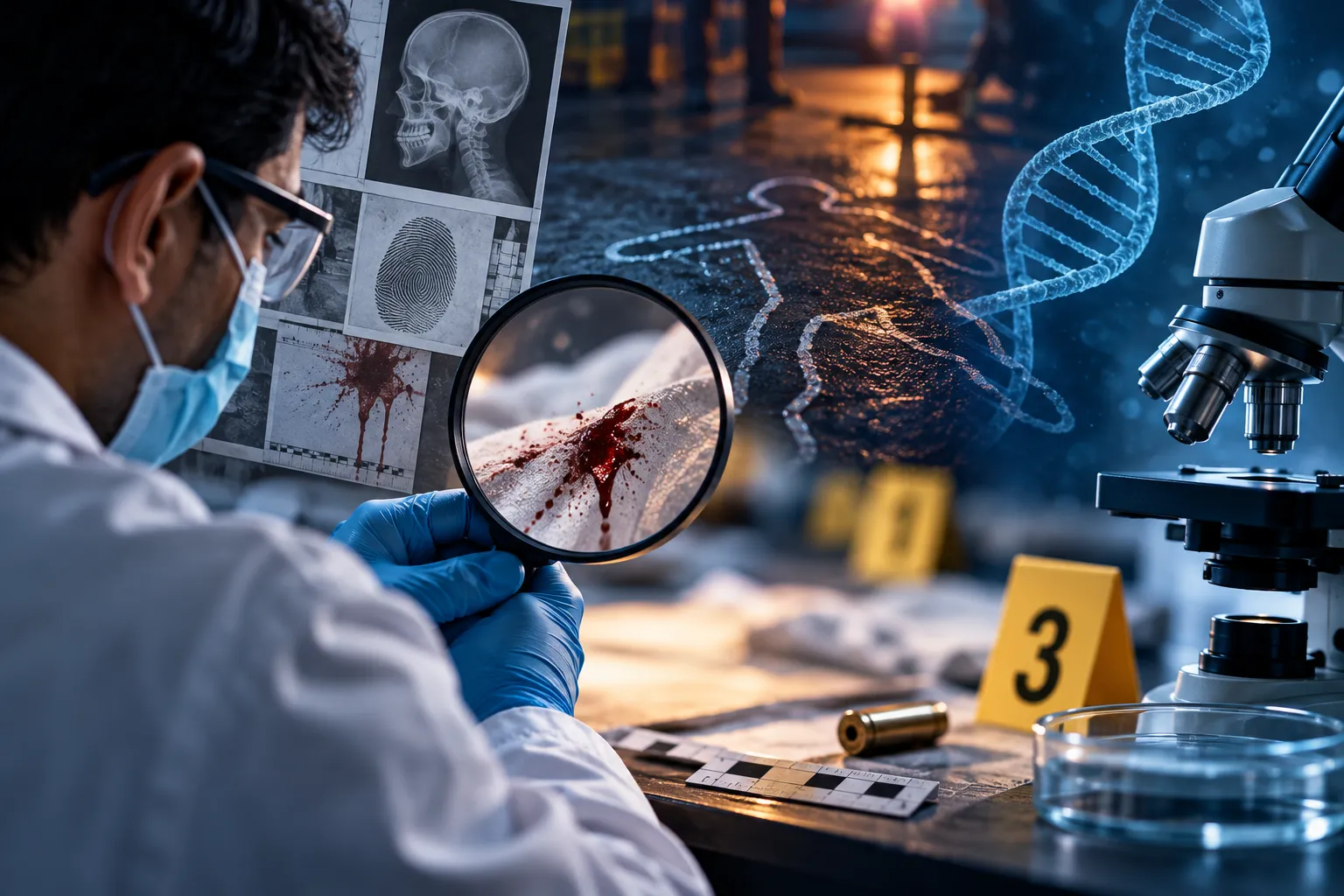
The presence, distribution and pattern of bloodstains at a crime scene may help investigators reconstruct events. Blood or other biological material can also be examined for DNA, potentially linking a person to a victim, object or location.
Other biological materials—such as saliva, hair, skin cells or tissue—may also provide valuable evidence in appropriate cases.
Modern forensic science has therefore moved far beyond simply examining the dead body.
Toxicology: the hidden crime
Sometimes there may be no obvious external injury.
A person may die because of poisoning, drug overdose or exposure to a toxic substance. In such situations, the forensic doctor may preserve appropriate samples of blood, urine, stomach contents, organs and tissues for toxicological examination.
Laboratory analysis can sometimes reveal substances that would otherwise remain hidden.
This is particularly important in suspected poisoning, drug-related deaths and unexplained sudden deaths.
Sexual offences
Forensic medicine also plays a vital role in investigating sexual offences.
A medical examination can document injuries and collect appropriate biological samples while also providing necessary medical care to the survivor. Importantly, the absence of visible injuries does not by itself prove that a sexual assault did not occur.
The forensic examination must therefore be conducted sensitively, scientifically and with respect for the dignity of the survivor.
The crime scene and the doctor
The role of forensic medicine is not confined to the mortuary.
Increasingly, forensic specialists may contribute to crime-scene investigation by interpreting injuries, assisting with evidence collection and correlating medical findings with the scene.
Photographs, radiology, DNA analysis, toxicology, histopathology and other scientific techniques can add different pieces to the same puzzle.
Science, not guesswork
Perhaps the most important principle of forensic medicine is objectivity.
A forensic doctor should not begin with the assumption that a particular person is guilty or innocent. The duty is to examine the evidence and report what the scientific findings support.
Sometimes the evidence confirms an investigator's theory. Sometimes it contradicts it. Both are valuable.
A forensic report is not meant to tell the court what decision to make. It provides medical and scientific evidence, while the court considers that evidence along with all other facts.
The final purpose
Forensic medicine provides scientific evidence that can help reconstruct what happened during an injury or death. Its findings may confirm or challenge the initial version of events and can become an important part of a criminal investigation and subsequent court proceedings.
The forensic doctor's responsibility is not to identify a culprit or decide guilt. It is to examine the available medical evidence objectively and present the findings without bias.
Ultimately, forensic medicine connects medicine, science and the law. By carefully interpreting injuries, laboratory results and other medical evidence, it helps investigators and courts understand events that might otherwise remain unexplained.
In the search for justice, good forensic work does not replace investigation—it strengthens it with evidence.
This version gives the article a cleaner, more professional ending and avoids repeating the same metaphor several times.