The Medical Reality Behind ‘Miracles’
Dr K.B. Suryakumar, Retd Professor of Forensic Medicine
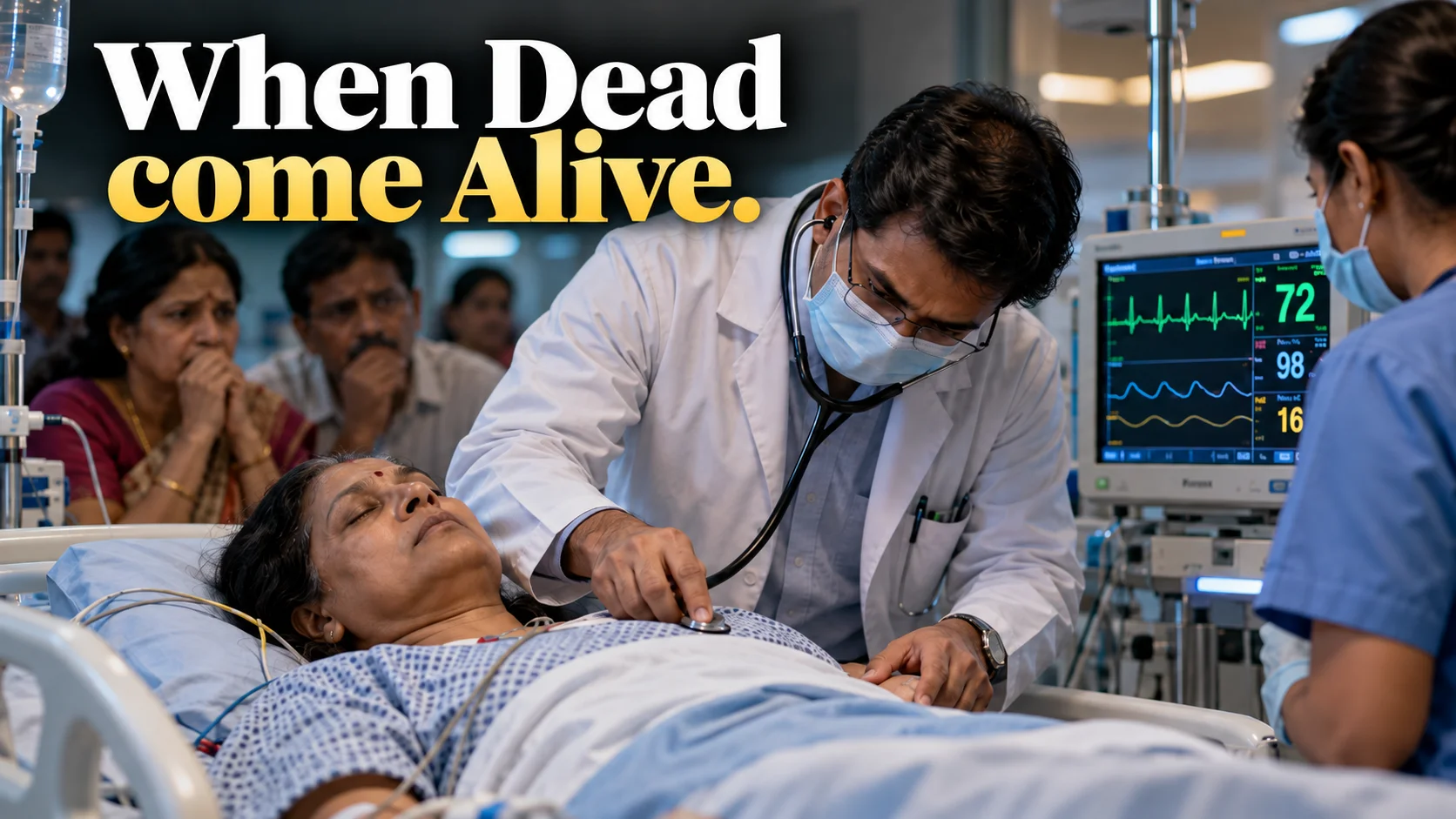
Some time back, a report from Haveri in Karnataka made headlines: a 45-year-old woman, presumed dead after a severe illness, was being prepared for her final rites when relatives noticed faint movement and shallow breathing. Rushed back to hospital, she survived. To her family, it felt like a miracle.
Such stories surface periodically across India and the world, rekindling awe, fear and confusion. Viewed through the lens of clinical medicine, however, they are not resurrections. They illustrate how thin, and sometimes deceptive, the line between ‘appears dead’ and ‘is dead’ can be.
Death Is a Diagnosis, Not an Appearance
Death is not something we intuit by looking at a still body; it is a formal clinical diagnosis, made using specific physiological criteria, ideally by a trained physician. A body that looks lifeless to a grieving relative is not the same as one confirmed dead by auscultation, ECG and clinical examination. This distinction lies at the heart of nearly every ‘back from the dead’ story.
Conditions That Convincingly Mimic Death
The human body can enter states so physiologically depressed that an untrained observer easily mistakes them for death:
Profound unconsciousness with a weak pulse. In severe shock or advanced heart failure, cardiac output may fall so low that the pulse cannot be felt by simple palpation, and breathing becomes too shallow to notice.
Agonal breathing. Around the time of cardiac arrest, patients often show irregular gasping, a reflex pattern unlike normal breathing that bystanders frequently misread.
Severe hypothermia. Profound cold slows metabolism, heart rate and respiration to a crawl. As emergency physicians put it, ‘A patient is not dead until they are warm and dead’, because cold can preserve organs even during prolonged cardiac standstill.
Overdose and metabolic collapse. Sedative or opioid overdose, severe hypoglycaemia, electrolyte imbalance and sepsis can cause deep coma with depressed breathing that looks like death to the untrained eye.
Respiratory arrest with a faint heartbeat. In airway obstruction or poisoning, breathing may stop while the heart still beats weakly. Prompt ventilation can reverse the situation before true cardiac arrest occurs.
When Resuscitation Truly Brings Someone Back
Two distinct scenarios are worth separating.
Return of spontaneous circulation (ROSC) is the expected outcome of successful CPR. When chest compressions, defibrillation and emergency drugs are delivered in time, the heart’s rhythm is restored. To onlookers this looks miraculous; medically, it is resuscitation working as intended.
The Lazarus phenomenon, or autoresuscitation, is far rarer. It is the spontaneous return of circulation after CPR has been stopped and death declared, sometimes several minutes later [1]. Two mechanisms are usually proposed. The first is dynamic hyperinflation: repeated compressions and ventilation can trap air in the lungs, raising intrathoracic pressure and reducing venous return to the heart. Once compressions stop, the pressure gradually dissipates and cardiac activity may resume. The second is delayed drug action: adrenaline given intravenously may not reach the central circulation until after the effort has been abandoned.
Autoresuscitation is not resurrection from true biological death. It is a delayed rebound in a body that had not yet crossed the point of no return. Because it is well documented, many authorities recommend observing the patient for several minutes after CPR stops before death is certified [2].
What Might Have Happened in Haveri?
Any such incident should be examined through two clinical questions.
First, who declared death, and on what findings? A family’s presumption based on stillness and cold skin is worlds apart from a physician’s declaration after checking heart sounds, pupillary reflexes and other objective signs. In rural or under-resourced settings, death is sometimes presumed by relatives or non-physician attendants, which is precisely where dramatic reversals tend to occur.
Second, was it spontaneous recovery, a delayed response or a missed sign of life? Post-arrest reflexes and agonal twitching can be mistaken for consciousness. Genuine recovery requires sustained consciousness, effective spontaneous breathing and stable circulation over time, not a single observed movement. In the Haveri case, faint movement and shallow breathing suggest a missed sign of life rather than a miracle, though only her treating doctors can say for certain.
A Note on History and Public Fear
Fear of being buried alive is not new. In 18th- and 19th-century Europe, it gave rise to ‘safety coffins’ fitted with bells or breathing tubes. Modern diagnostic tools have largely removed this risk, but incidents like the one in Haveri show that vigilance remains essential wherever formal medical certification of death is skipped or rushed.
The Takeaway
For the public, the message is simple: an unresponsive person who is not breathing normally should never be assumed dead. Call emergency services at once and begin CPR if cardiac arrest is suspected, because every minute matters. A doctor’s confirmation, not a relative’s impression, should decide when efforts end.
For healthcare providers, these cases are a reminder that death is a meticulous clinical process, not a snap judgement. Until irreversible death is conclusively established, every reversible cause of apparent death deserves urgent intervention.
Sometimes what looks like a miracle is simply medicine that has not finished its work.
References
1. Gordon L, Pasquier M, Brugger H, Paal P. Autoresuscitation (Lazarus phenomenon) after termination of cardiopulmonary resuscitation – a scoping review. Scand J Trauma Resusc Emerg Med. 2020;28:14.
2. Hornby K, Hornby L, Shemie SD. A systematic review of autoresuscitation after cardiac arrest. Crit Care Med. 2010;38(5):1246–53.